


A resident signs a 12-month lease at $1,800 with six weeks free. A year later, you offer $1,850. Your rent roll shows a 2.8% increase. The resident is looking at about $258 more a month.
That gap will come up in a lot of 2027 renewals. Nearly 30% of properties ended October offering a concession to new residents, the highest month to month share in more than a decade, according to ALN Apartment Data. Concessions were more widely available than a year earlier in 85% of markets, and the average incentive at properties in lease-up was 6.4 weeks free.
If you used concessions to fill apartments this year, pull those leases before the renewal offers go out. Start with what each resident paid over the full term, then decide how much of an increase to ask for at renewal.
What net effective rent means at renewal
Net effective rent is the average monthly rent over the lease term after concessions. To calculate it, multiply the monthly rent by the number of months, subtract the total dollar value of the concession, and divide by the number of months.
On that $1,800 lease with six weeks free, the resident’s net effective rent was about $1,592. An offer at $1,850 with no concession raises their average monthly cost by about 16%. A site team working from the 2.8% figure is going into a very different conversation than the resident.
We covered how move-in discounts can create problems down the road in The Biggest Mistakes Operators Make With Rent Concessions. Here’s what you can do when those leases come up for renewal.
Five ways to price the first renewal
Say your starting renewal price is $1,850. Here’s what five offers would mean for the same resident and what each would cost the property.

Going straight to $1,850 may make sense if similar apartments are leasing at that price and you can absorb a vacancy if the resident leaves. Stepping down to three weeks free spreads the increase across two renewals. The resident pays about $151 more per month this year. If the following renewal comes in at $1,900 with no concession, the next increase is about $157.
Two weeks free with a deadline gives the resident a reason to decide sooner. Holding the rent for 15 months moves the expiration by three months, which may be worth $750 if it puts the unit into a better leasing window.
Rolling the full six weeks forward keeps the increase to about $44 a month today. It also leaves you with a similar decision a year from now.
Set the concession up front so you can tell whether it worked
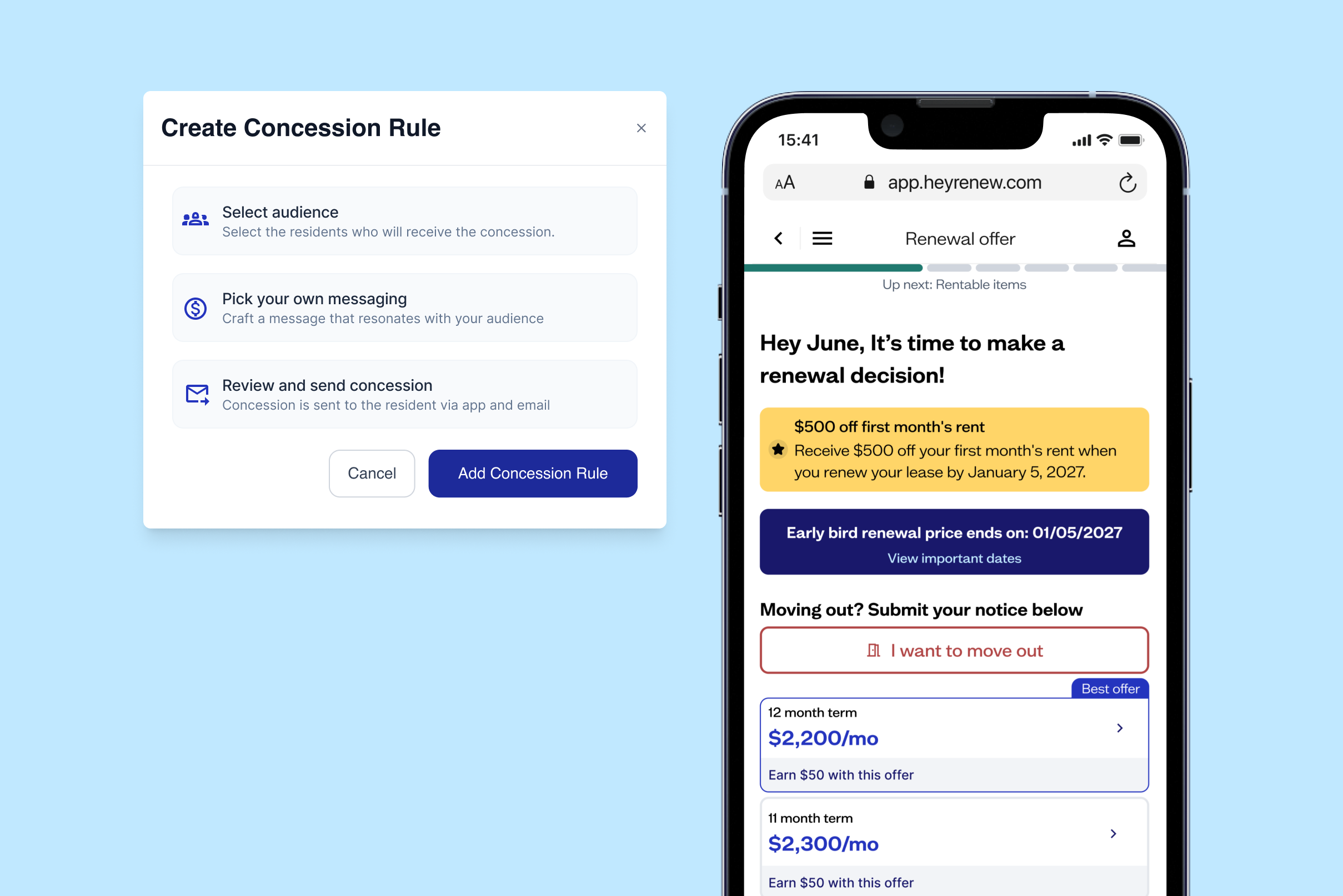
One operator we work with offers a month and a half free as its standard renewal concession, plus another two weeks if the resident signs within about two weeks of receiving the offer. Another offers a month free and holds the rent on longer terms. A third told us they often have to “cater individual negotiations” when offers come in above market.
From January through October 2026, we looked at sent renewal offers with an active concession across 10 Renew operators. In 1,010 of 1,507 offers, or 67%, the concession was added after the initial send. The median was three days later.
That timing matters when you look at the results. Say your team adds a concession after a resident pushes back on price. If you compare that offer with one the resident accepted immediately at full rent, you’re comparing two households that were already on different paths. The concession may have saved a renewal even if offers with concessions had a lower acceptance rate overall.
Here’s how I’d run the comparison.
- Set the terms before the offer goes out. Write down which leases qualify, how much you’ll offer, and when it expires.
- Track exceptions. Give site teams room to negotiate within clear limits and record when an offer changes. You’ll want to know which residents received the original offer and which received something different.
- Compare similar leases. Start with the same community, similar expiration dates, and comparable increases in net effective rent. A three-week concession offered on a 16% jump is doing a different job than the same concession on a 5% jump.
- Wait for the full renewal cycle. Two weeks of signatures can tell you whether an offer prompted early decisions. Give the rest of the cohort time to decide before you compare renewal rates.
- Look at what residents signed. Track renewal rate, how often offers changed during negotiations, and the net effective rent on the signed lease.
Decide which offer makes sense
Before approving a concession, ask four questions.
- How much is the resident’s rent going up? Compare the proposed offer with their current net effective rent. A $258 monthly increase deserves a different conversation than a $50 increase.
- What are residents asking for? If residents are coming back to the site team about the monthly price or lease length, use that feedback to decide which offers to test on comparable leases.
- What could they rent nearby? Look at net effective rents on similar available units. If the property down the street is offering six weeks free, include that in the comparison.
- What would a turn cost? Renew estimates about $4,000 in avoided turnover costs when a household stays. Use your property’s vacancy, make-ready, and leasing costs to run the comparison locally. Check what it would take to sign a replacement lease, too. ALN reported an average incentive of 3.9 weeks free at mature stabilized properties in October. At $1,850 a month, that’s about $1,665.
If a three-week renewal concession costs $1,281 and you expect to offer $1,665 in concessions to sign a new lease, the step-down is worth considering. The question is whether those three weeks are likely to change the resident’s decision.
What to do this quarter
- Pull the leases expiring in 2027 that had a move-in concession and group them by expiration month.
- Calculate the change in net effective rent at the planned renewal price.
- Review the biggest increases alongside nearby rents and expected turn costs.
- Decide which offers each community can use, who can change them, and when they expire.
- Once residents have decided, compare acceptance rates and signed net effective rents for similar offers.
If your team already has a rule for that first renewal after a concession, I’d like to hear how it’s working.
How Renew helps you manage renewal concessions across properties
If one community offers three weeks free up front and another adds it after residents push back, you’ll have a hard time comparing the results. Start by giving both teams the same rules for when to offer the concession, how long it’s available, and when to make an exception. That gives you a clearer basis for deciding where to keep the offer, where to scale it back, and where to try something different.
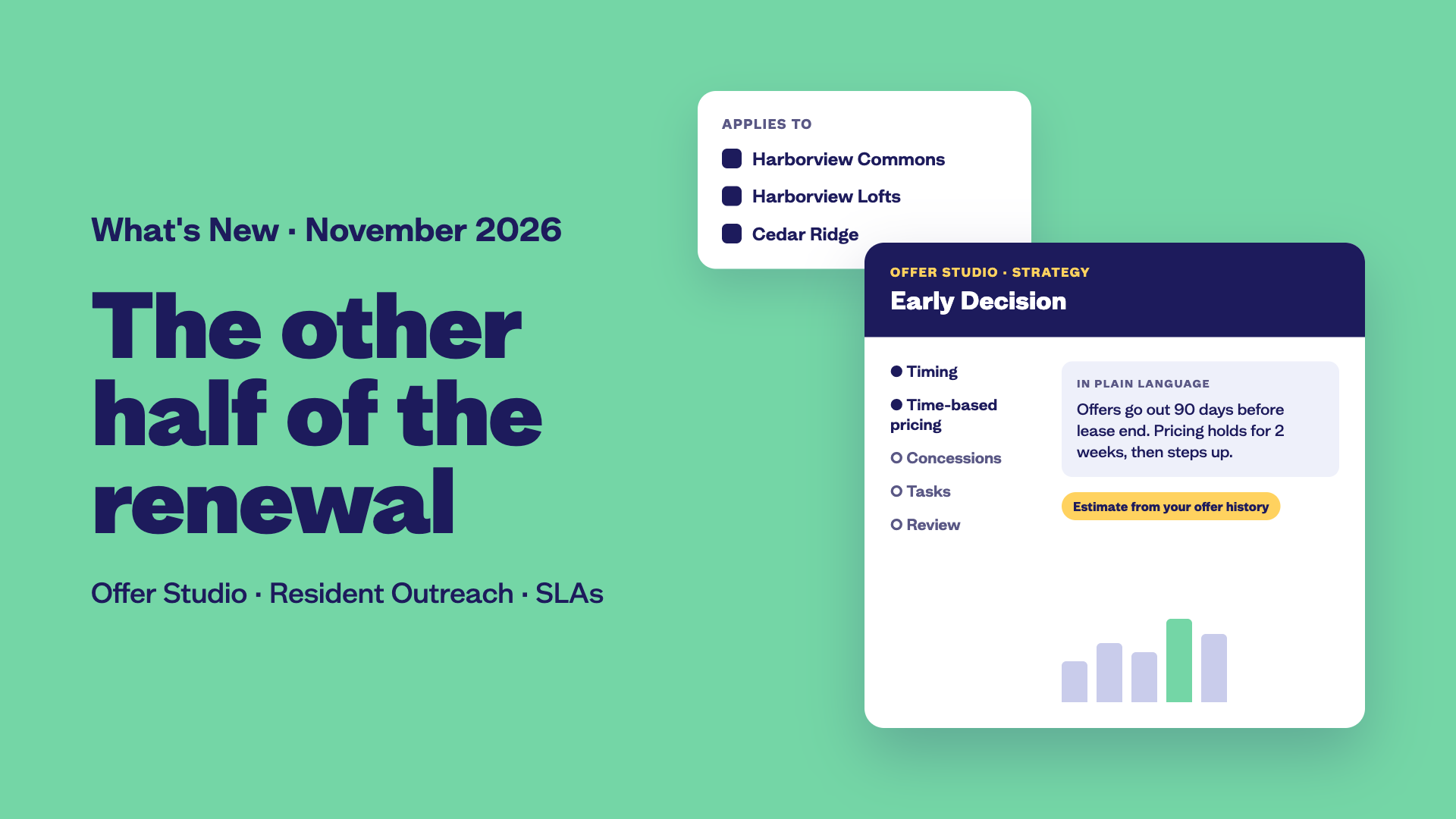
That’s part of what we’re building with Offer Studio. Revenue and operations teams can build a reusable renewal strategy, set offer timing and pricing rules, and assign it to the communities where it makes sense. Offer Studio is in limited preview with select operators. See what’s in the preview and how to request access.