



Ask an operator what renewal increase they’re targeting, and they’ll usually have an answer.
Ask when residents should receive the offer, how that price should change as the deadline approaches, what the site team can adjust, and whether all of that happened as intended, and the answer takes a little longer.
Often, it takes a few phone calls.
That’s a lot of uncertainty around a decision that affects revenue, occupancy, and the team’s ability to plan for the next several months.
Multifamily has invested heavily in getting the price right. There’s still plenty of work to do between that recommendation and a signed renewal. We’re investing in giving operators more control over that part of the process, starting with Offer Studio, now in limited preview.
We’re also welcoming Girish Gehani, Chief Operating Officer of Trilogy Real Estate Group, as a strategic advisor. Girish has spent years connecting portfolio decisions to property operations, and his experience will be valuable as we build relationships across the systems and teams involved in renewals.
An earlier answer gives everyone more options
A renewal decision has a clock attached to it.
Until a resident decides, the team is planning around a possibility. They may have a renewal coming. They may have a turn coming. They still need to prepare for both.
An earlier commitment gives the operator more certainty. An earlier notice to vacate gives the team time to plan the turn and market the apartment. A resident who raises a concern earlier gives the team time to address it.
That’s why the structure and timing of an offer deserve attention alongside the price.
When does the resident receive it? What are they being asked to decide, and by when? Does the offer give them a clear reason to act? What happens if they need help or want to discuss it?
The answers shape how quickly a team gets clarity and how predictable the renewal process becomes.
They also shape the resident’s experience. A clear offer with understandable terms gives someone a better starting point than a number followed by a series of conversations about what might be possible.
A strategy has to reach the property
At the portfolio level, a renewal strategy can sound straightforward.
Send offers a certain number of days before expiration. Use a defined pricing schedule. Make a particular concession available through a specific date. Give local teams room to respond within agreed limits.
Then the strategy has to make its way through regional managers, community teams, and the systems they use.
Someone has to enter the settings. Someone has to explain the approach. Someone has to decide what to do when a resident asks for an exception.
Each step creates an opportunity for the offer to drift from what leadership intended. A deadline gets extended. A price changes. A concession is applied differently at two communities.
Those decisions may be reasonable in context. Leadership still needs to see them and understand their effect.
Site teams need that clarity, too. They’re the ones answering questions at the desk and explaining why an offer changes after a certain date. A strategy is much more useful when it comes with direction they can follow and clear limits for the decisions they can make.
What goes into a renewal offer
Renewal strategy includes several connected decisions:
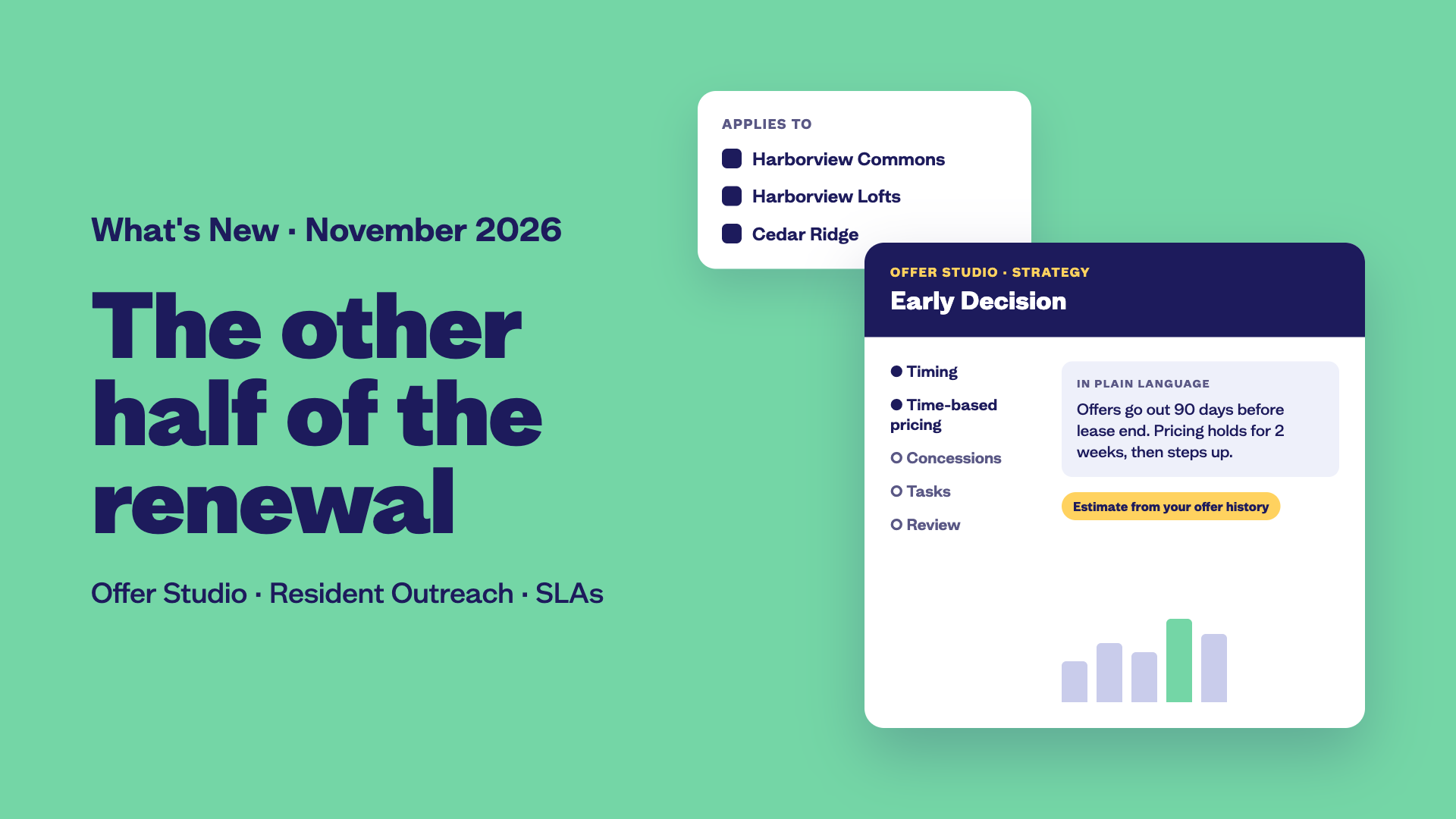
- Timing. How far ahead of lease expiration the offer goes out and when the resident’s response is due.
- Time-based pricing. Whether the offered rent changes as the decision deadline approaches, giving residents a clear reason to commit earlier.
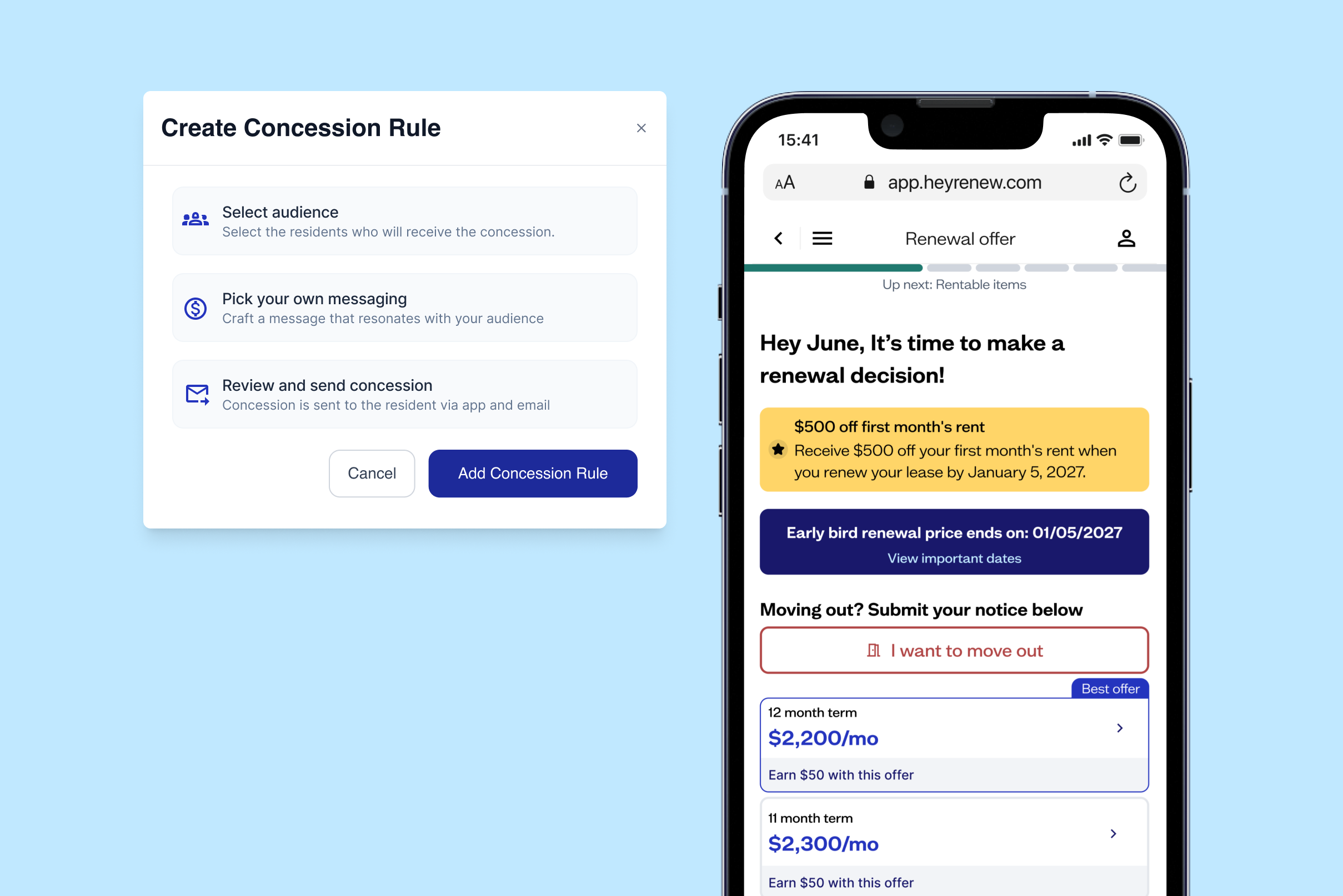
- Concessions. Which incentives are available, who qualifies, and when they expire.
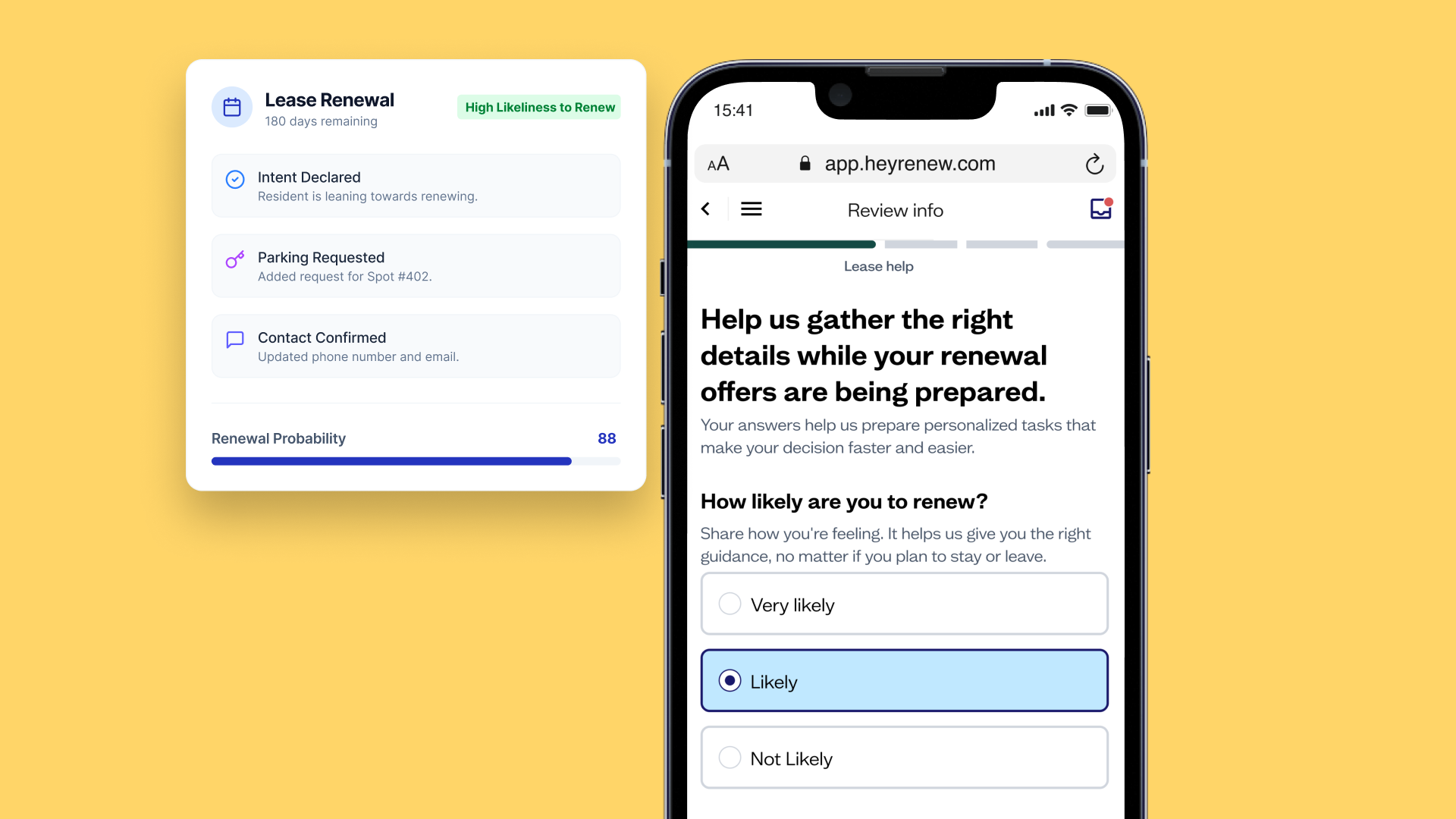
- Resident tasks. What residents need to complete before signing, such as confirming contact information, answering a pre-renewal survey, or providing proof of renters insurance.
These choices should work together. A deadline has limited value if it’s routinely extended without anyone knowing. A time-based pricing schedule is difficult to evaluate if teams frequently change it and those changes aren’t visible.
Operators need a way to define the approach, carry it through to the offer, and understand the result.
That’s what we’re designing Offer Studio to support.
What we’re building with Offer Studio
Offer Studio is designed to work with the property management and revenue management systems operators already use.
The idea is to give teams a consistent way to manage the decisions surrounding the renewal price, with three core capabilities.
Build strategies teams can reuse
Operators can create named strategies that bring together offer timing, pricing schedules, concessions, and resident tasks.
Naming and saving the strategy matters. It gives everyone a shared reference for what a community is using and makes it possible to apply that approach again without rebuilding it from memory.
Set defaults with room for local judgment
Strategies can be assigned across the portfolio or to individual communities, with guardrails defining where local teams can make adjustments.
The design allows offers syncing from the property management system to follow those defaults, reducing the need for teams to re-enter settings.
Leadership gets a way to establish a consistent approach. Community teams get clearer direction and know where they have flexibility.
Connect results to the strategy behind them
Each offer is associated with the strategy that produced it. That connection is designed to let operators compare results by community, region, and month using their own portfolio history.
How quickly did residents decide? How often were offers negotiated down? How much of the intended rent reached the signed lease?
Those measures help an operator assess whether an approach is doing what they expected and where it needs attention.
Consistency doesn’t mean every community gets the same offer
A stabilized community with long-tenured residents may need a different approach from a property competing with several new lease-ups.
The operator should be able to make that choice deliberately.
For example, one community might use a time-based pricing schedule to encourage earlier commitments. Another might keep pricing consistent through the decision window while sending offers further ahead of expiration.
In either case, the team should understand the approach, the resident should receive the intended offer, and leadership should be able to assess the results.
That’s the kind of consistency we’re after: confidence that the chosen strategy is being carried out, with enough visibility to learn from it.
If one approach produces earlier decisions but more negotiations, that’s worth understanding. If another preserves more of the intended increase but leaves the team waiting longer for answers, that’s a tradeoff the operator should be able to evaluate.
The goal is to make those choices visible and measurable.
Why Girish’s perspective matters
Girish co-founded Trilogy Real Estate Group in 2008 and oversees its operations and property management business, Trilogy Residential Management.
He led Trilogy’s transition from third-party management to a fully vertically integrated platform. That included consolidating property data across management systems and building training programs for site and maintenance teams.
He understands how much work sits between a decision at the corporate office and a consistent practice at the property.
That experience is especially relevant to where we’re headed. Renewal strategy touches property management systems, revenue management platforms, resident communications, and the people responsible for putting all of it to work.
Girish will advise us on distribution partnerships across property management, revenue management, and resident experience platforms, along with our work with owners and operators. He’ll help us understand how Renew can fit into the way these organizations operate and build stronger relationships across the industry.
“When you manage through multiple teams and systems, you need confidence that the decisions you make are being carried out at the property. Renewals are a good example. You want residents deciding earlier, teams working from clear direction, and results you can trace back to the approach you chose. That’s what interests me about what Renew is building.”
I’m excited to have him involved because he’ll bring practical questions to the conversation. How will this fit into an operator’s existing systems? What will a regional manager need to see? What will make it easier for a community team to follow through?
Those questions will help us build something operators can use.
Help shape what comes next
Offer Studio is in limited preview with select operators, and their feedback is helping shape the product.
We’re focused on giving teams earlier answers, more consistent execution, and a clearer understanding of what their renewal strategies deliver.
If your team has invested in revenue management and wants more visibility into what happens between the recommended price and the signed renewal, we’d like to hear from you.
Ask about the Offer Studio preview.
Read the full announcement: Trilogy Real Estate Group COO Girish Gehani Joins Renew as Strategic Advisor.