.svg)

.svg)


.png)
For years, the multifamily resident retention playbook has looked something like this: host the pool party. Bring in the food truck. Plan the holiday mixer. Maybe throw in a pet costume contest if you're feeling ambitious.
There’s nothing wrong with any of it. Good resident events can make a community feel like a community. It gives neighbors a reason to meet each other, site teams a chance to build relationships, and residents another reason to enjoy where they live.
But somewhere along the way, the resident events calendar became the entire resident retention plan.
It’s a little like a company trying to solve employee retention with free beer and a ping-pong table. The perks are nice. But if someone feels underpaid, hates their commute, has outgrown their role, or needs a different kind of flexibility, Friday happy hour probably isn’t saving them.
Modern companies have gotten much smarter about this. They look at how an individual employee’s relationship with the company is changing over time: their needs, engagement, circumstances, and likelihood of staying.
Multifamily can take a page from that playbook.
Because a resident appreciation event treats 200 households as an audience. A strong retention strategy understands them as 200 different trajectories.
The Limitations of Resident Events for Retention
Imagine five residents living in the same apartment community.
They swim in the same pool, use the same package room, get invited to the same resident events, and probably receive the same emails. But beneath that, the trajectories they’re on are totally different:
- One just got engaged and is starting to think that one-bedroom feels pretty small for two people.
- Another loves her apartment, but a recent rent increase has her doing some mental math.
- Another started a new job across town, turning a 15-minute commute into 45.
- Another had a frustrating maintenance experience and has been a little less enthusiastic about the place ever since.
- The fifth? Perfectly happy. Planning to renew. Probably wondering when the next food truck is coming.
Same community. Five very different relationships with it.
That’s the fundamental limitation of a resident retention strategy that puts all of its eggs in the events basket.
Events are built around shared experiences for one community. A solid retention strategy needs to see all the unique trajectories unfolding inside that community — because retention hinges on individual needs, circumstances, and reasons to stay.
You might also like: Turning Resident Retention Ideas Into Resident Retention Strategies
Modern Retention Strategies Follow the Individual
Companies have been learning this lesson with their employees for years.
The era of treating office perks as a retention strategy gave us some fun things. Cold brew on tap. Nap pods. Foosball tables nobody remembers asking for.
It also became pretty clear that perks could only do so much when an individual employee’s underlying reasons for leaving went unaddressed.
People leave jobs for different reasons and on different timelines. Compensation starts feeling uncompetitive. A manager relationship deteriorates. Someone stops seeing a path forward. Their family circumstances change. Their priorities shift.
The useful question becomes: How is this person’s relationship with the company changing?
Residents aren’t so different.
Someone doesn’t suddenly become a “renewal” 90 days before lease end. They’ve been living a life in that apartment for the previous nine months, and that life keeps changing.
Their household changes. Their budget changes. Their job changes. Their opinion of the property changes. What they want from their next home changes.
Events are points in time. Trajectories show direction.
And when you're trying to keep someone from leaving, direction is awfully useful.
You might also like: Personalized Lease Renewals at Portfolio Scale: A 2026 Guide
The Renewal Decision Is a Moment. The Trajectory Starts Months Earlier.
Most multifamily operations are naturally organized around milestones: Move-in. Resident survey. Renewal offer. Notice. Move-out.
But residents don’t really organize their thoughts around your operating calendar. Several months before their lease is up, a resident might:
- Start wondering whether they really need to keep paying for a two-bedroom.
- Notice an apartment building closer to work a few weeks later.
- Then, a friend sends them a listing.
- Then they browse a few apartments on a Sunday afternoon, mostly out of curiosity.
- Then they see a move-in special that makes moving look a little more appealing.
By the time the renewal offer lands in their inbox, the decision to leave may feel brand new to the operator. But to the resident, it’s been developing for months.
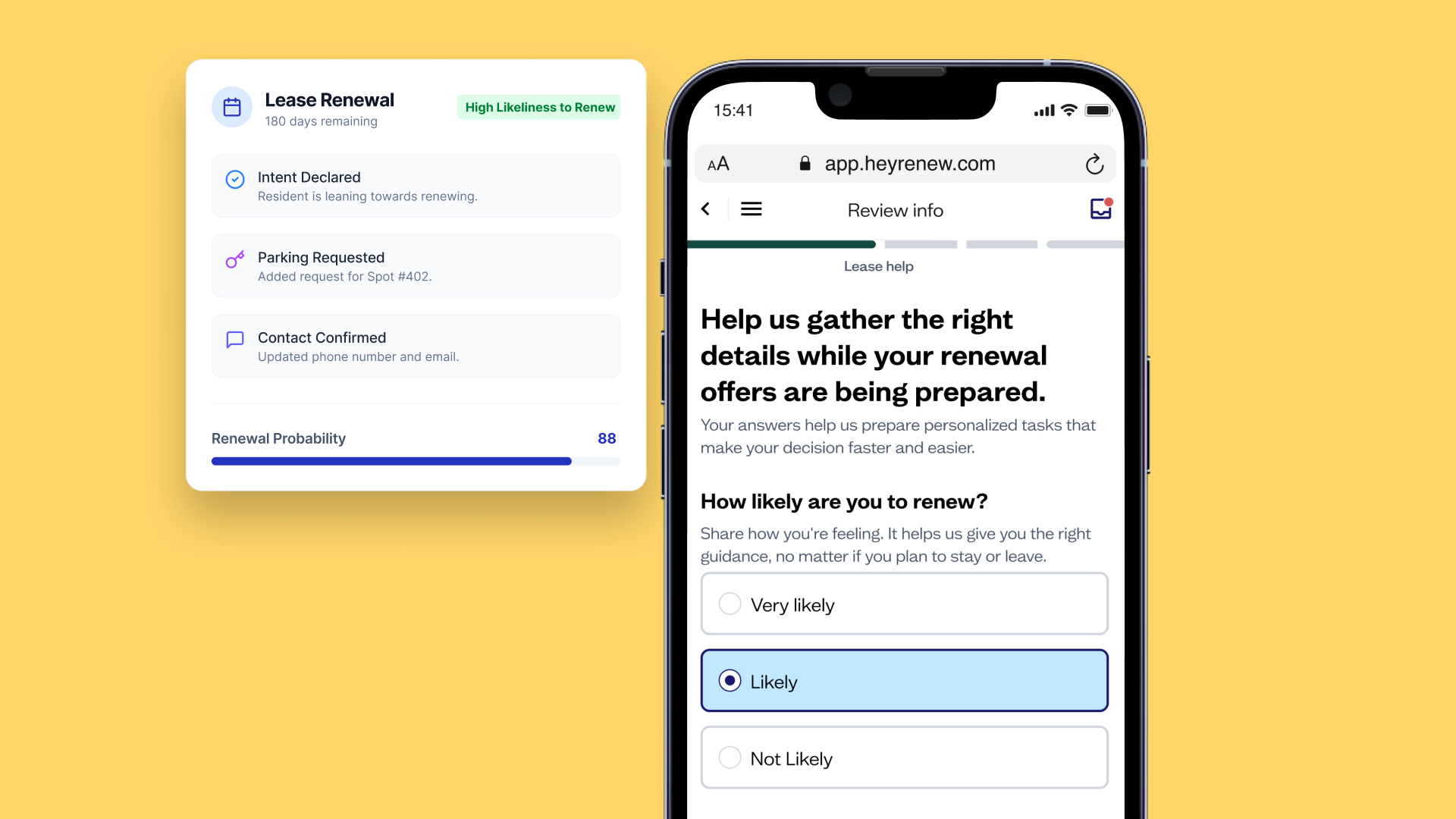
That’s one reason Renew’s Resident Retention Intelligence starts well before the traditional renewal window — bringing together behavioral signals like engagement and satisfaction, household information, and Likeliness to Renew scoring to flag move risk up to six months before lease end.
Instead of waiting for one big retention moment, operators get an evolving picture of resident intent: who’s leaning toward staying, and who’s starting to lean out.
That trajectory toward departure isn’t a verdict. The earlier teams see it, the more opportunity they have to address drift — before the resident makes up their mind.
Match the Retention Strategy to the Resident
Now, let’s go back to our five residents.
Giving all five a renewal concession would be expensive. Giving all five a call would eat up site-team time. Inviting all five to another resident event might make for a fun Thursday evening, but it still wouldn't address what each person needs.
Understanding their individual trajectories gives you much better options:
- The resident running out of space could see a two-bedroom elsewhere in the portfolio.
- The resident increasingly worried about price might warrant a targeted pricing strategy or concession.
- The resident frustrated by a maintenance experience gives the site team an opportunity to fix the relationship while it’s still fixable.
- The resident happily cruising toward renewal may need very little intervention at all.
- And someone leaving for a reason the property simply can't solve may still be a great candidate for an in-network move.
Renew turns those differences into something teams can actually use. Site teams get a daily prioritized list of which residents need attention, why, and what retention action to take, so they can focus their energy where it has a chance to change an outcome.
This is where trajectory-based retention starts to have real operational value. Knowing more about each resident changes where you spend your time, attention, and concession dollars.
Keep the Pool Party. Upgrade the Retention Strategy.
Nobody needs to cancel Taco Tuesday.
Resident events still have a place. Community matters. Resident experience matters. Giving people reasons to enjoy where they live is a good thing, full stop.
But while every resident may be invited to the same event, they’re not all headed in the same direction.
Some are settling in. Some are starting to question whether their apartment still fits. Some need a different floor plan, price point, or location. Some are quietly inching toward the door.
The opportunity is seeing those trajectories before they turn into move-outs.
That’s what Behavioral Intelligence brings to resident retention: a clearer view of who’s leaning in, who’s leaning out, what’s changing, and where there’s still an opportunity to influence what happens next.
Keep the food trucks. Keep the pool parties.
Just don’t let the events calendar become the whole retention strategy.

.png)
.png)
.png)
.png)
.png)
.png)
.png)
%20(1).png)
.png)
.png)
.png)
.png)
.png)
.png)
.png)

.png)
.png)
.png)
.png)
.png)
.png)
.png)
.png)

.png)
.png)

.png)

.png)






.png)
.png)
.png)