.svg)

.svg)


.png)
There are plenty of good reasons to offer a deal on rent.
Maybe you’re leasing up a new community. Maybe one floor plan has been sitting too long. Meanwhile, competitors down the street are throwing around “six weeks free” like confetti. And a longtime resident is weighing a renewal against a very tempting listing three blocks away.
That’s what rent concessions are for. They give operators another lever to pull when the economics call for it.
The trouble starts when pulling that lever becomes muscle memory. Concessions get expensive when they’re offered too broadly, kept around too long, or used to solve a problem they can’t actually fix.
The goal isn’t to get stingier with rent concessions. It’s to get smarter about when, where, and why you use them.
Below, we’ll get into some of the biggest ways rental concession strategies go sideways, plus what property managers can do differently. But first:
What Is a Rent Concession?
A rent concession is an incentive a property owner or manager offers to encourage someone to sign, renew, or otherwise move forward with a lease.
If you’re looking for the simplest rent concession definition, think of it as something of value that makes the lease more attractive to the resident or prospect.
That can include:
- Weeks or months of free rent
- Reduced rent for a set period
- Waived application or administrative fees
- Free or discounted parking
- Reduced deposits or move-in costs
- Gift cards
- Renewal credits or incentives
A move-in concession is what most people typically picture when they think of rental concessions. But concessions aren’t limited to a one-time deal on new leases. Operators can also use lease concessions at renewal when there’s a strategic reason to encourage an existing resident to stay.
The important word there is strategic. Because the question shouldn’t just be whether to offer a concession. It’s who gets one, how much, when, and what you expect it to accomplish.
That sounds straightforward. In practice, there are plenty of places to get it wrong.
8 Rental Concession Mistakes Operators Make
Mistake #1: Making Concessions the Default Setting
When occupancy gets uncomfortable, concessions tend to multiply.
First it’s one property. Then a floor plan. Then suddenly everybody gets $500 off because that’s what the comp down the street is doing.
Sometimes broad apartment concessions are exactly what market conditions call for. Lease-ups, seasonal softness, excess exposure, and a competitive submarket can all justify aggressive incentives.
But “the market is tough” is a pretty loose spending policy. Every concession should have a job. Are you trying to:
- Accelerate absorption?
- Move a particular floor plan?
- Protect occupancy through a seasonal dip?
- Save a price-sensitive resident?
Start with the specific problem, then determine where a concession can actually help solve it.
Mistake #2: Paying Residents to Do What They Were Already Going to Do
Imagine two residents approaching renewal:
- Resident A is happy, engaged, and already planning to stay.
- Resident B is increasingly price-sensitive and considering alternatives.
- Both get $100 off per month.
You may have influenced Resident B. Resident A just got a very nice surprise.
Over a 12-month lease, that’s $1,200 in concession value. Repeat that across dozens or hundreds of residents who didn’t need an incentive, and blanket renewal concessions get expensive fast.
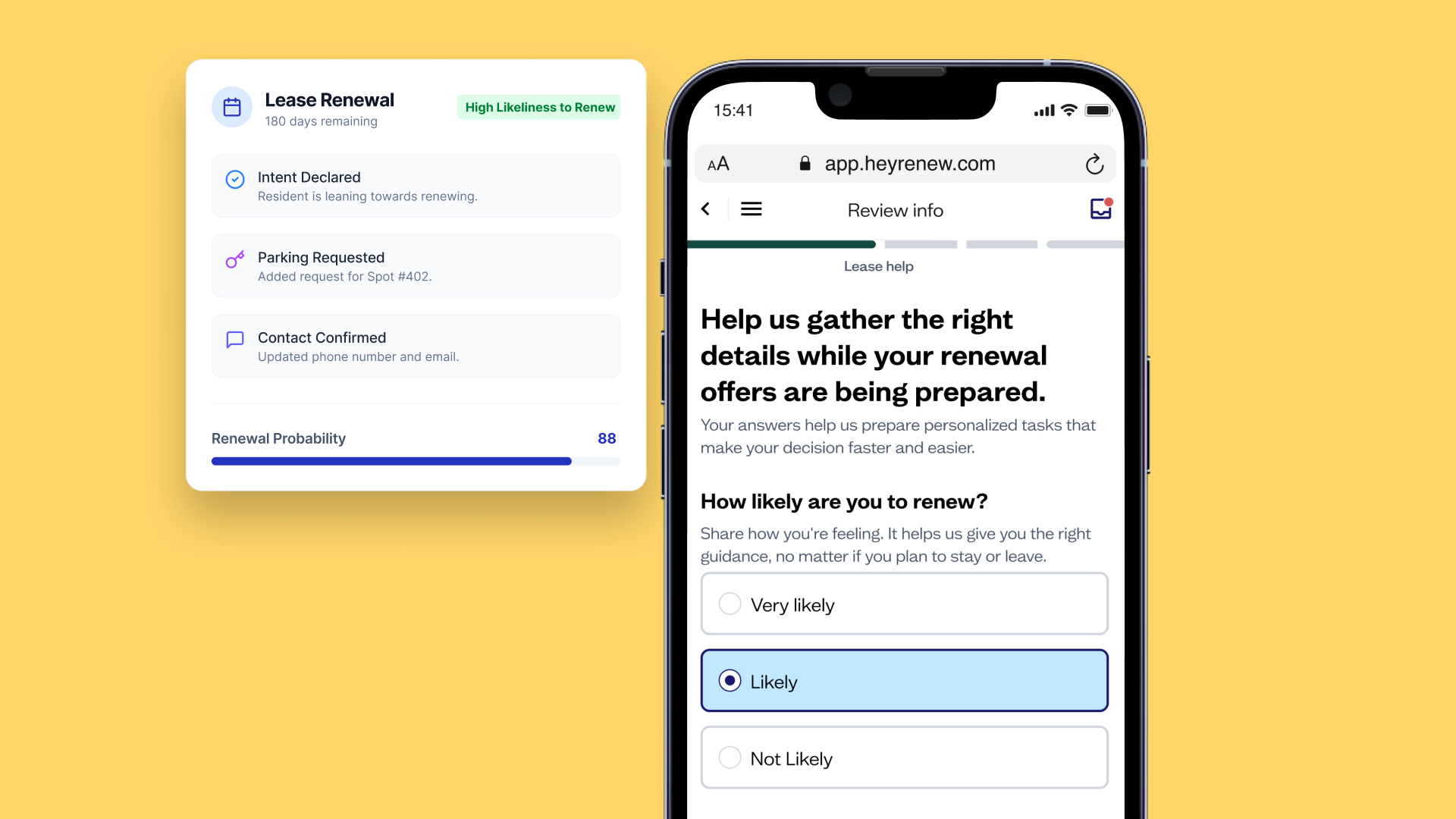
Residents enter renewal with different levels of satisfaction, price sensitivity, intent, and move risk. Renew Signal captures those signals up to six months before lease end, giving teams a better read on who may actually need an incentive and why.
Mistake #3: Sweetening the Deal Before You Know Why It Didn’t Work
A resident doesn’t bite on a $500 renewal credit. So, how about $750?
Before bidding against yourself, figure out what the first offer told you.
If the resident is price-sensitive and still weighing their options, increasing the incentive may make sense. If they need another floor plan or are shopping a different neighborhood, another $250 may accomplish exactly what the first $500 did.
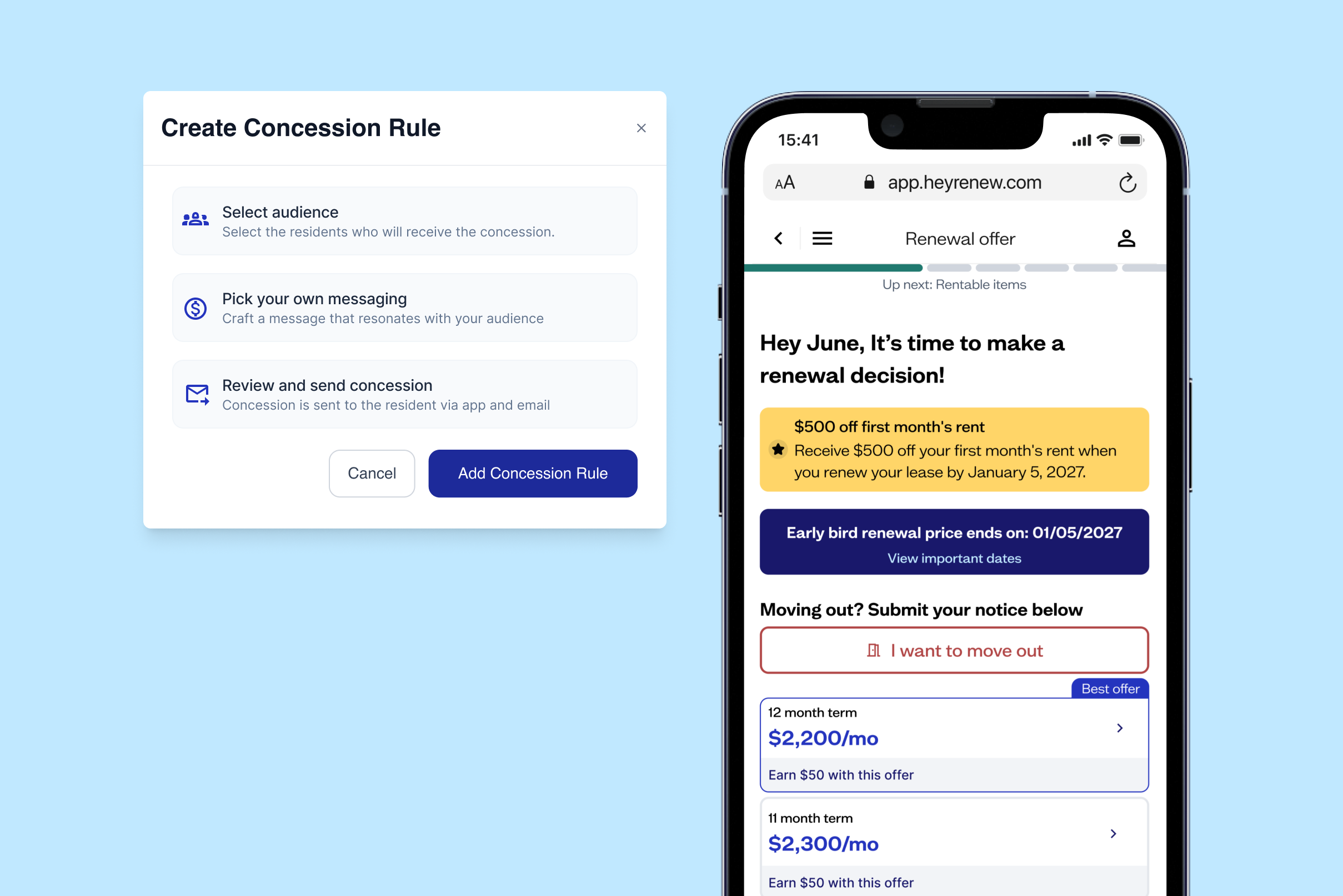
Treat a rejected concession as information about what should happen next. Renew Impact carries Signal’s resident-level intelligence into a fully managed renewal pipeline, powering targeted concessions and dynamic pricing based on real-time renewal intent.
Sometimes, pricing isn’t the problem. When $100 off won’t make another bedroom appear or shorten a new commute, Renew routes those residents toward better fit in-network options instead.
Mistake #4: Focusing on the Amount and Ignoring the Structure
Operators tend to discuss concessions in dollars: $500 off, one month free, $100 per month. But how you deliver the incentive can matter almost as much as how much you give.
The same economic value could be structured as an upfront credit, a monthly discount, a fee waiver, or a time-bound renewal incentive. Each puts the savings in a different place and can affect cash flow, effective rent, urgency, and how the resident experiences the deal.
The right structure depends on the friction you’re trying to overcome:
- Trying to reduce the upfront cost of moving? A one-time credit or fee waiver puts the savings where those costs hit hardest.
- Trying to overcome a monthly affordability objection at renewal? Spreading the incentive across the lease lowers the resident’s ongoing payment.
- Trying to get a decision sooner? A time-bound incentive gives the resident a reason to act before the offer expires.
Getting more out of a concession can also mean changing its shape, not just its size.
Mistake #5: Forgetting That the Concession Eventually Ends
Here’s where a great Year One deal can make for an awkward Year Two conversation.
Take a $2,000 apartment with two months free on a 12-month lease. The resident’s effective monthly rent is about $1,667. At renewal, an offer of $2,050 with no concession looks like a $50 increase on paper. From the resident’s bank account, it feels more like $383.
That concession burn-off matters. An aggressive move-in concession can drive demand today while setting up a much bigger perceived increase at renewal. If the discounted effective rent was what put the apartment within budget, returning to full rent may put it right back out of reach.
That doesn’t mean aggressive concessions are a bad move when market conditions call for them. It means operators should factor the eventual burn-off into the acquisition decision and anticipate the retention challenge it could create.
Year Two deserves a seat at the table when you’re planning Year One.
Mistake #6: Getting the Timing Wrong
The same $500 concession can be unnecessary on one day and too little, too late a few months later.
Offer it before a resident has shown meaningful price sensitivity, and you may be paying someone who was already planning to renew. Wait until they’ve toured three properties, found a favorite, and started pricing movers, and you’re asking $500 to unwind a much more developed decision.
The useful window is when price is influencing the decision and the decision is still movable.
That window looks different for every resident. With Renew, concessions can be timed around when an individual resident is actually weighing the decision, rather than automatically showing up at the same point in every renewal cycle.
That means fewer dollars spent too early and a better shot at making them count when it matters.
You might also like: Lease Renewal: How Far in Advance Should I Send the Offer?
Mistake #7: Letting Yesterday’s Concession Run Today
Concessions have a habit of overstaying their welcome.
A promotion gets introduced to solve a problem. Leasing improves. Exposure comes down. Market conditions shift.
But the promotion remains.
Every rent concession should have an objective and a review date. Track whether the conditions that justified it still exist, including occupancy, exposure, leasing velocity, competitive offers, effective rent, and performance by floor plan.
That last part matters. If studios are flying and two-bedrooms are sitting, they probably don’t need the same deal. The same goes for two properties performing very differently within the same portfolio.
Concession strategy should move when the market moves.
Mistake #8: Counting the Dollars Without Measuring What They Bought
You spent $40,000 on concessions last quarter.
Okay. What happened?
Did they increase conversion or retention? Which offers worked? How many residents would have signed anyway? And did the spend cost less than the vacancy or turnover it prevented?
Concession spend tells you what went out. Concession ROI tells you what came back.
For renewal incentives, incrementality matters. Giving a discount too much credit for a resident who was already likely to stay can make an expensive strategy look more effective than it is. And when a resident declines anyway, that outcome has something to teach you too.
This is where Renew’s intelligence becomes useful after the decision, not just before it.
With After the No intelligence, operators can connect concession strategy with renewal outcomes and resident behavior to understand where incentives actually changed the result, where they didn’t, and what that means for the next round of offers.
The goal is to get beyond “How much did we spend?” and answer the much more useful question: “What did that spend actually buy us?”
Make Every Lease Concession Earn Its Keep
There will always be a place for rent concessions in multifamily.
Sometimes free rent gets a stubborn unit leased. A renewal incentive keeps a resident who was genuinely on the fence. Or waiving a fee is exactly what gets a solid deal across the line.
The opportunity is knowing the difference between those moments and the ones where you’re simply giving money away. That takes better visibility into demand, resident intent, price sensitivity, renewal behavior, and outcomes.
With Renew, operators can see resident risk earlier, understand what’s behind it, and make more targeted retention decisions while there’s still time to influence outcomes.

.png)
.png)
.png)
.png)
.png)
.png)
.png)
%20(1).png)
.png)
.png)
.png)
.png)
.png)
.png)
.png)

.png)
.png)
.png)
.png)
.png)
.png)
.png)
.png)

.png)
.png)

.png)


.png)






.png)
.png)
.png)