.svg)

.svg)


.png)
Look up when operators should send residents their lease renewal agreement, and you'll find a remarkably consistent answer: somewhere between 60 and 90 days before a lease expires.
That’s been the default timeline across multifamily for pretty much forever. Leasing teams expect it. Revenue management systems are built around it. For most operators, it's simply how renewals have always been done.
The only problem? Residents’ decision-making and shopping behavior doesn’t wait for an industry timeline to kick in.
Long before a formal lease renewal notice lands in their inbox, many residents have already started weighing their options. They're checking pricing, talking with a partner or roommate, browsing nearby communities, and quietly deciding whether another year still feels right.
That raises a more interesting question than when to send a renewal offer:
When does the renewal decision process actually begin for residents?
When you understand the answer, you understand just how many renewal conversations start after the most important part of the decision has already happened. Below, we'll look at why the 60-to-90-day standard became the norm, and when the better time is to send a lease renewal notice if resident retention is your goal.
Where did the 60-to-90 day renewal window come from?
The 60-to-90-day renewal window didn't appear out of thin air. It was a response to some very real operational challenges.
Pricing changes quickly. Operators need time to fill unexpected vacancies. Revenue management systems work best with relatively predictable inventory. And residents need enough notice to make other plans if the terms in a lease renewal agreement don’t work for them.
So, sending out lease renewal letters two to three months before lease end became the default solution. It's important to recognize, though, what this window was designed to optimize.
It was built around when operators needed answers — and not necessarily when residents began making decisions.
Increasingly, those timelines don’t overlap.
3 myths behind traditional lease renewal timelines
The industry has more information today than it did when the 60-to-90-day renewal window became the norm. Because of that, a few long-held assumptions are worth revisiting:
Myth #1: "If we start earlier, our pricing will be wrong."
This is probably the biggest concern operators raise, and it's understandable. Nobody wants to lock into pricing months before market conditions change.
But beginning the renewal process earlier doesn't mean publishing final pricing six months ahead. It means understanding who is already leaning toward renewing, who needs a conversation, and who may require additional attention before pricing becomes the deciding factor.
Modern revenue management is already dynamic. Renewal strategy can be, too.
Myth #2: "Giving residents more time just encourages them to shop."
Here's the reality: many already are.
Residents don't wake up 90 days before move-out and suddenly begin thinking about where they'll live next. They browse listings during lunch breaks. They compare rents after hearing a friend's apartment costs less. They search when another building advertises a concession.
Most of that behavior happens quietly.
The difference today is that multifamily behavioral intelligence can surface those moments early enough for operators to respond before a resident is too far down the ILS rabbit hole.
You might also like: The Future of Resident Retention Is Behavioral Intelligence
Myth #3: "We don't want residents to feel pressured."
Fair enough. Nobody enjoys feeling rushed into a major life decision. But there's a difference between forcing an early commitment and starting an earlier conversation.
Allowing more runway often creates a better resident experience. Residents have time to ask questions, explore different floor plans, consider a transfer within the portfolio, or simply plan ahead without feeling cornered by a deadline.
As our co-founder Rob likes to say, it gives people time to plan like humans — not game show contestants.
And if residents don’t hear your number until day 60 or 90, you haven’t actually kept the pressure off. You’ve sent them exactly one signal: “This will cost more.”
In a soft market, that’s risky. It’s better to keep leverage in check with deadlines and price steps, not silence.
When exactly do residents start making renewal decisions?
This is where the conversation starts to change.
We’ve seen that residents start shopping ~150-180 days out, and over half decide before a 60-to-90 day offer even arrives. The signals are all there in resident behavior, if you know where to look.
You might also like: The Real Signals That Show Resident Renewal Is at Risk
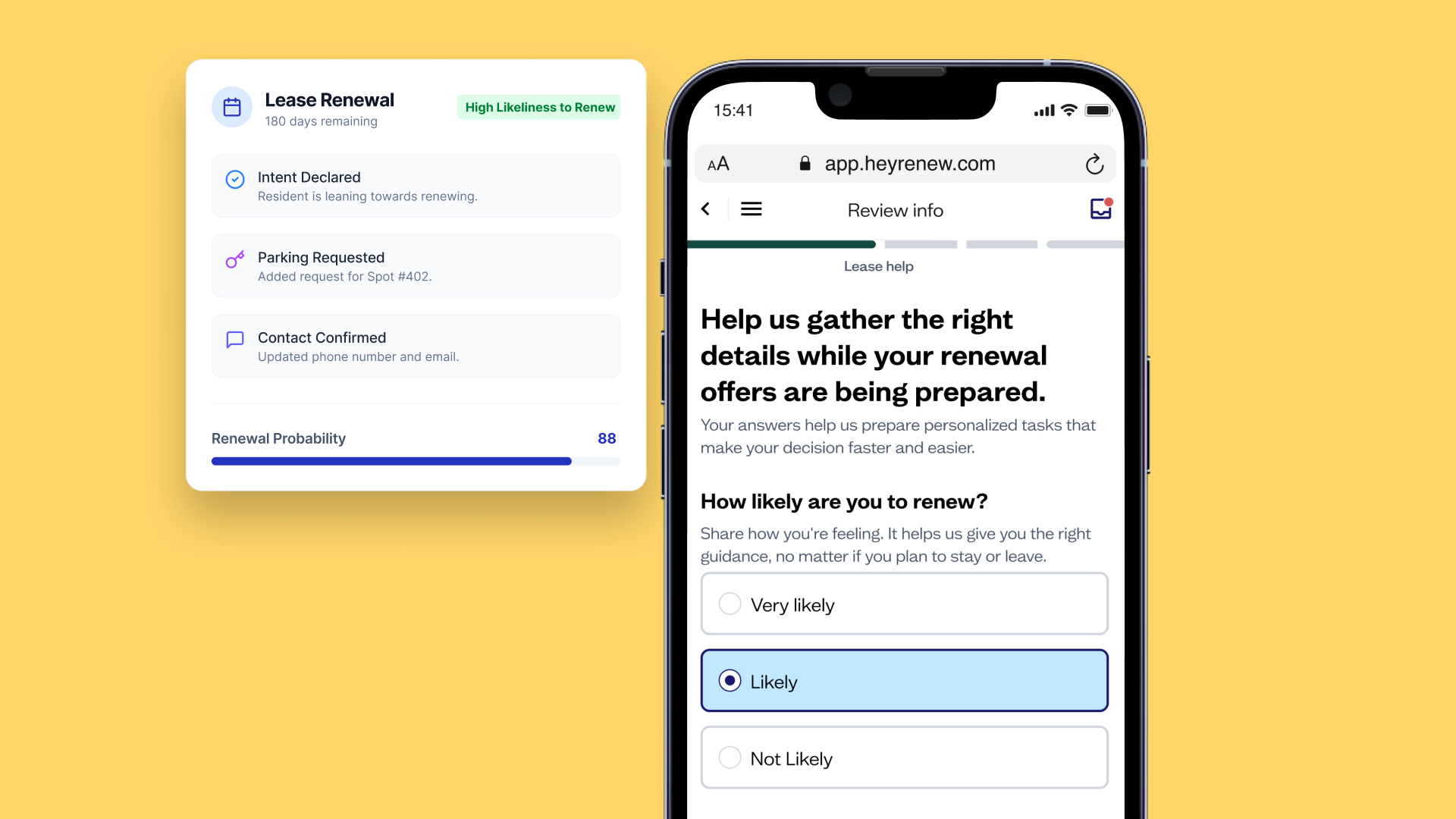
Small behavioral changes — portal activity, satisfaction signals, household updates, and other everyday interactions — can reveal renewal intent long before a decision is fully made or notice is formally given.
A few revealing patterns in our data:
- Many residents show meaningful renewal intent signals a full 6 months before lease expiration.
- Declared intent points to a similar timeline: 91% of residents who say they’re likely to renew 6 months in advance, do.
- Across the industry, the average resident makes a renewal decision about 42 days before lease expiration. Renew customers start the process earlier and get decisions sooner: an average of 72 days before lease expiration.
- 68% of renewals or NTV decisions happen 60+ days before lease end with Renew.
- 57% of renewing residents whose operators use Renew decide within 14 days of viewing their offer .
That last statistic feels especially telling.
If someone is able to decide within days of seeing an offer, the offer probably didn't create the decision. In many cases, it simply confirmed one that was already taking shape.
The impact of earlier renewal visibility
Starting the lease renewal process sooner isn't only about improving renewal rates. (Although it does that, too: Operators using Renew for earlier, smarter retention plays see a 18.5% lift in renewal rates compared to the national average.)
Earlier visibility into renewal intent can also change how operators manage an entire portfolio.
Instead of treating every upcoming renewal the same, site teams can focus on the residents whose decisions are still influenceable, reducing wasted effort. Regional leaders gain a clearer picture of future occupancy. And asset managers get a more reliable view of renewal pipeline health, instead of waiting for signed paperwork to understand what's coming.
Pricing decisions become more strategic, because they're based on emerging resident behavior rather than assumptions. Marketing teams can allocate advertising budget more efficiently. Even concessions become more targeted, because operators know which residents genuinely need an extra push and which were already planning to stay.
The renewal timeline stops feeling reactive and starts becoming something operators can actively manage.
So, how far in advance should you start a lease renewal?
There isn't a single number that's right for every market, portfolio, or pricing strategy.
A formal lease renewal letter could make sense ~120 days out from lease expiration when possible. It may also still make sense around the 90-day mark, depending on your strategy, operational workflows, and local regulations. (Case in point: in many parts of the West Coast, residents require 180 days written notice before any rent increase.)
Even if you stick relatively close to traditional lease renewal timelines, what should change is everything that happens before that point.
Ideally, operators should begin understanding renewal intent months before a resident is eligible for a formal offer. That doesn't mean asking for an early commitment. It means using the extra runway to remove uncertainty from the process.
A timeline might look something like this:
- 120-180 days before lease expiration: Identify which residents are likely to renew, which are undecided, and which may be quietly preparing to leave. Use that lead time to resolve concerns, explore in-network transfer opportunities, and focus proactive outreach where it's most likely to change the outcome.
- 90-120 days: Deliver the formal lease renewal agreement with a much clearer understanding of each resident's likelihood to renew. Tailor pricing, concessions, and follow-up based on the renewal intent you've already observed.
- After the offer: Don’t send the offer and go dark. This is your window for timely follow-up, answering questions, and addressing last-minute concerns before a decision becomes final.
Without the tools to first flag and then act on renewal intent, this level of targeted strategy is likely too tall an order for site teams' bandwidth. A Resident Retention Intelligence platform is what makes the whole playbook practical — surfacing renewal intent up to 6 months in advance, prioritizing outreach automatically, and guiding site teams toward the next best retention action for every resident.
.png)
.png)
.png)
.png)
.png)
.png)
.png)
%20(1).png)
.png)
.png)
.png)
.png)
.png)
.png)
.png)

.png)
.png)
.png)
.png)
.png)
.png)
.png)
.png)
.png)
.png)

.png)

.png)






.png)
.png)
.png)