.svg)

.svg)


.png)
Most multifamily operators measure resident satisfaction by asking residents how they feel on a survey. These surveys can provide useful feedback, but they only capture a single moment in time.
The resident experience is shaped by hundreds of interactions, from maintenance requests and communication touchpoints to pricing conversations and renewal decisions. By the time concerns show up in a standard resident satisfaction survey, important decisions may already be underway.
Residents might be:
- Delaying a renewal decision
- Disengaging from communications
- Exploring alternatives
- Preparing for a move
The operators seeing the strongest retention outcomes are measuring something bigger. They're paying attention to resident behavior, engagement patterns, operational performance, and decision signals across the resident lifecycle.
That requires a broader approach to measurement — one that captures how residents engage, communicate, and make decisions over time.
What Traditional Resident Satisfaction Surveys Miss
Resident satisfaction surveys have long been a standard tool for measuring resident experience. They can help operators understand sentiment, but they often leave important questions about resident decision-making unanswered.
Several factors contribute to that gap:
Low response rates create blind spots.
Even well-run surveys typically hear from only a fraction of residents. That means operators are often drawing conclusions from a relatively small set of experiences while many others go unheard.
The result is an incomplete picture of resident experience, particularly when engagement levels vary across properties, resident segments, or stages of the lease lifecycle.
Feedback often arrives after decisions are already forming.
Resident decisions rarely happen all at once.
A resident who eventually chooses to move out may have been weighing that decision for weeks or months before expressing dissatisfaction. By the time feedback appears in a survey, important signals may have already surfaced through earlier interactions and behaviors.
Surveys might provide a valuable snapshot of resident sentiment, but only after key decisions are already in motion.
Surveys measure opinions, not behavior.
Resident feedback is important, but it's only one source of information.
Every day, residents generate signals through their interactions with the property. Communication engagement, maintenance activity, portal usage, and workflow completion all provide insight into how residents are experiencing the community.
Viewed together, those behaviors can reveal shifts in engagement long before they appear in a survey response.
Satisfaction snapshots rarely explain why residents stay or leave.
Even when surveys do accurately capture resident sentiment, they rarely tell the full story behind a renewal decision.
Residents weigh a wide range of factors when deciding whether to stay, including location, lifestyle needs, family circumstances, commute changes, school districts, pricing, and available alternatives.
A resident may be happy with their experience and still move because their needs have changed. Another may renew despite frustrations because the property continues to meet important priorities.
A more useful question is:
How likely is this resident to continue a relationship with us?
Answering that requires visibility into the decisions residents are making, the options they're evaluating, and the signals they generate as they move toward a renewal or move-out decision.
You might also like: What Renters Want: The Data On Why Residents Move Out (2026)
The Signals That Predict Resident Satisfaction Earlier Than Surveys
Resident experience leaves a trail of observable signals across daily operations. Rather than relying on occasional feedback, operators can use these signals to build a more continuous view of resident satisfaction.
1. Behavioral Signals
Behavior often reveals engagement levels before residents explicitly express them.
Examples include:
- Portal logins
- Communication engagement
- Response times
- Service request activity
- Renewal interactions
These actions help operators understand whether residents are actively participating, disengaging, or delaying decisions.
2. Operational Signals
Many of the strongest drivers of satisfaction are operational.
Examples include:
- Maintenance response times
- Resolution quality
- Communication turnaround times
- Consistency of follow-through
These metrics reflect the property's ability to deliver on resident expectations.
3. Relationship Signals
Some indicators reveal the overall strength of the resident relationship.
Examples include:
- Renewal engagement
- Lease milestone interactions
- Community participation
- Interest in other properties within a portfolio
These signals help operators understand how connected residents feel to the property and operator over time.
Taken together, behavioral, operational, and relationship signals provide a more dynamic view of resident experience. Satisfaction becomes visible through actions, long before it would’ve appeared in survey feedback.
Few moments bring these signals together as clearly as the renewal process.
Why Renewal Behavior Is One of the Clearest Indicators of Resident Satisfaction
The renewal moment is one of the clearest windows operators have into the resident experience.
When a resident receives a renewal offer, they're weighing a lot more than the proposed rent increase. They're considering everything that's happened since move-in, from maintenance experiences and day-to-day communication to the overall value they feel they're receiving from the property.
That evaluation often shows up in their behavior.
- How quickly do they view the renewal offer?
- How many times do they return to the offer portal before taking action?
- Do they engage with renewal materials without responding?
- What questions arise during the process, and when do they ask them?
Those interactions can reveal valuable context about how residents perceive their experience and where uncertainty may exist.
You might also like: What Renewals Could Be: Reimagining Efficiency, Revenue, and Resident Mobility
Turning Resident Satisfaction Into Portfolio Visibility
Most operators already have access to plenty of resident data. The challenge is that communication history, maintenance activity, renewal engagement, leasing workflows, and survey responses tend to live in separate systems.
When those signals are viewed independently, important patterns can be easy to miss:
- Residents who stop engaging with renewal communications may also have unresolved maintenance requests.
- A property experiencing slower service response times may see more residents delaying renewal decisions.
- What initially appears to be a pricing concern may actually be rooted in a broader experience issue.
Bringing those signals together creates a clearer picture of the resident experience, individually and at scale. Operators can start to identify:
→ Which properties consistently generate stronger resident engagement
→ Where friction is causing residents to delay renewal decisions
→ Which resident segments may be showing early signs of disengagement
→ How operational performance is influencing retention outcomes
That visibility makes it easier to spot trends earlier, prioritize resources more effectively, and create a more consistent resident experience across the portfolio.
Resident Satisfaction Is a Signal, Not a Score
Resident satisfaction surveys still have a role to play. But satisfaction also isn't something to measure once and reviewe later. It's an ongoing signal shaped by countless everyday interactions, operational experiences, and communication touchpoints — the kind that don't show up in a typical survey result.
The operators gaining the clearest understanding of resident experience are connecting engagement patterns, operational performance, and renewal behavior signals to identify friction earlier and better understand retention outcomes.
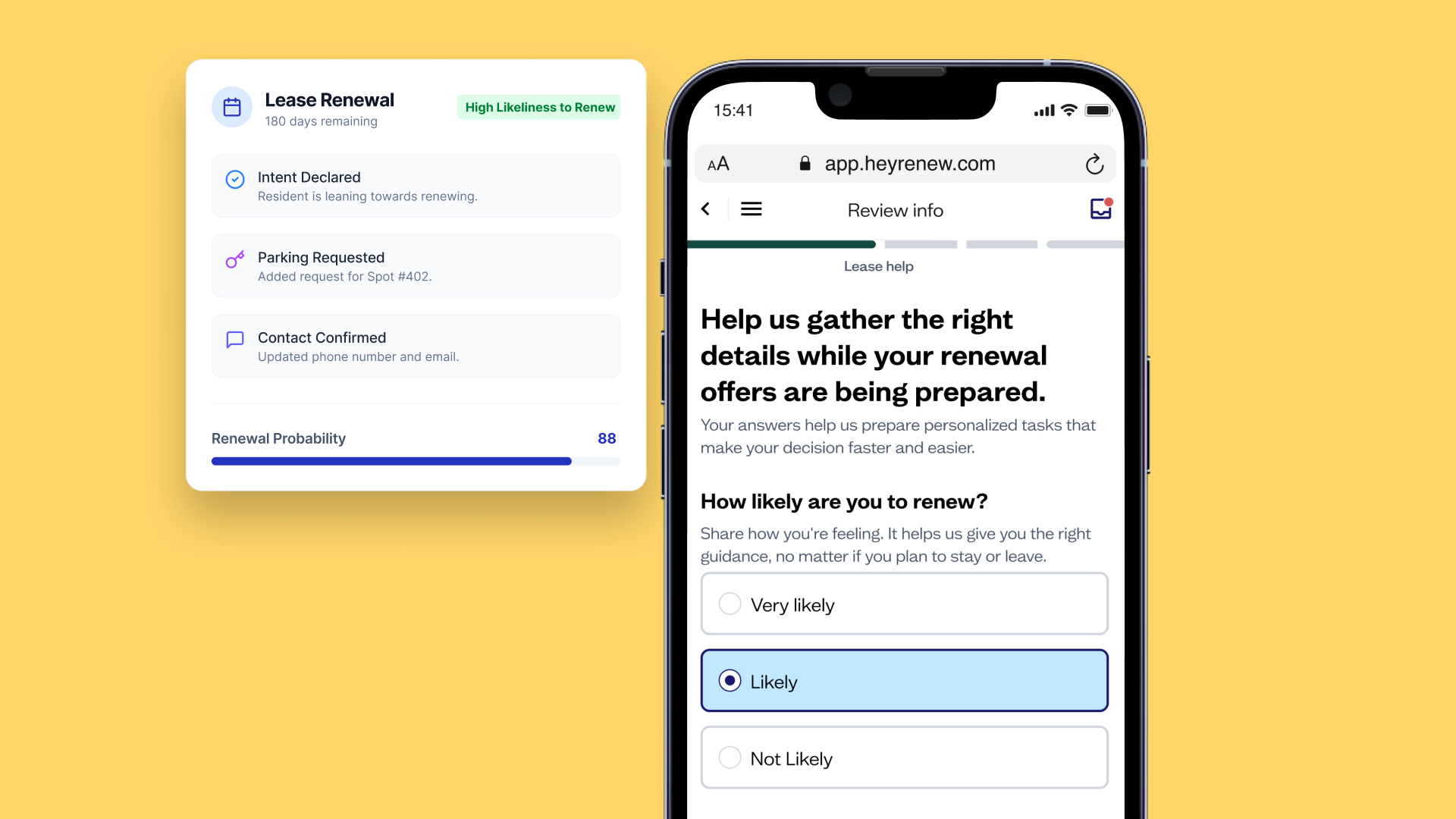
That's exactly what Renew is designed to do. By bringing resident engagement, renewal activity, communication history, and decision signals into a single workflow, Renew gives teams greater visibility into resident intent, retention risk, and the factors influencing renewal decisions.
The result isn’t just earlier visibility into vacancy exposure. It’s more opportunities to increase resident satisfaction and create experiences that encourage residents to stay.


.png)
.png)
.png)
.png)
.png)
.png)
.png)
.png)
%20(1).png)
.png)
.png)
.png)
.png)
.png)
.png)

.png)
.png)
.png)
.png)
.png)
.png)
.png)
.png)
.png)
.png)

.png)

.png)






.png)
.png)
.png)