.svg)

.svg)


.png)
How to build “next best fit” paths, instead of just “stay put” campaigns.
Every multifamily operator knows this scenario:
A resident gives notice on a solid apartment. No complaints. No clear operational issues. They just leave.
Then a few weeks later, they show up somewhere else nearby — still renting, and sometimes even paying more.
Multifamily tends to treat these moveouts as unavoidable churn. Case closed. But in reality, many were simply responses to a life change:
- A roommate moved out
- A couple moved in together
- Remote work changed space needs
- A budget shifted
- A job relocated
In other words, the apartment stopped fitting the moment. It happens constantly in multifamily, but most renewal strategies still aren’t built for that reality.
Instead, retention revolves around just one goal: keeping residents in the same unit. The bigger opportunity? Identifying where a resident wants to go next and helping them get there — before they disappear into the broader market.
To do that, operators have to start thinking beyond unit retention and toward true resident retention.
The Problem With Unit-Based Resident Retention Strategies
Most multifamily retention systems are designed around preserving occupancy at the apartment level.
The renewal workflow, the reporting structure, the leasing targets, the marketing strategy — they all center on the same question:
Can this specific apartment be renewed for another term?
That approach works, until the resident’s needs change. Once the apartment no longer fits their life, the system usually moves in one of two directions:
- Keep trying to retain the resident in-place
- Prepare to replace them entirely
There’s very little infrastructure built around the space in between. And that exposes a major inefficiency in multifamily economics.
Even though a large chunk of moveouts continue renting in the same market, operators are left to spend heavily on ILS platforms, paid search, concessions, vacancy exposure, and turnover costs to replace them.
So, the industry pays to reshuffle renters between professionally managed communities, and the resident relationship resets with every address change. Resident LTV stays limited, and operators stay stuck in a constant reacquisition cycle.
The operators pulling ahead are taking a different approach: making resident mobility part of the retention strategy itself.
The Real Opportunity: Life-Transition Retention
One of the challenges in multifamily is that operators rarely get visibility into what residents do after deciding not to renew.
Renew Marketplace creates visibility into that moment. When residents submit an NTV, they’re shown other apartments within the same portfolio that may better fit what’s changed in their lives.
That changes outcomes. One example: The roommate-breakup-to-1BR pipeline.
Every year, thousands of leases end because two people in a 2-bedroom no longer want to live together. Multifamily usually treats that as unavoidable churn.
But when those residents explored other in-portfolio apartments through Renew Marketplace, a different pattern emerged:
- Most moved from a 2BR to a 1BR
- Many increased their monthly rent, even when downsizing
- A meaningful share stayed in-portfolio when that path was surfaced
The resident relationship clearly still had value. The current apartment is what didn’t.
This same dynamic shows up across all kinds of life transitions:
- A growing family looking for another bedroom
- A remote worker needing office space
- A resident downsizing after a breakup or divorce
- Someone relocating within the same operator footprint
- A renter looking for lower monthly costs without leaving the area
- A pet owner needing a different building policy
These residents aren’t always trying to leave the portfolio. They’re just trying to solve for a different version of fit.
Operators who recognize that early can build a fundamentally different kind of retention strategy — one designed to guide residents toward the next best fit, instead of treating every move as lost demand.
How to Build “Next Best Fit” Paths
This is where operators start retaining the resident relationship, not just the current lease.
Instead of treating renewal as a binary stay-or-leave decision, operators can start building pathways around the life transitions that commonly reshape housing needs.
A few examples:
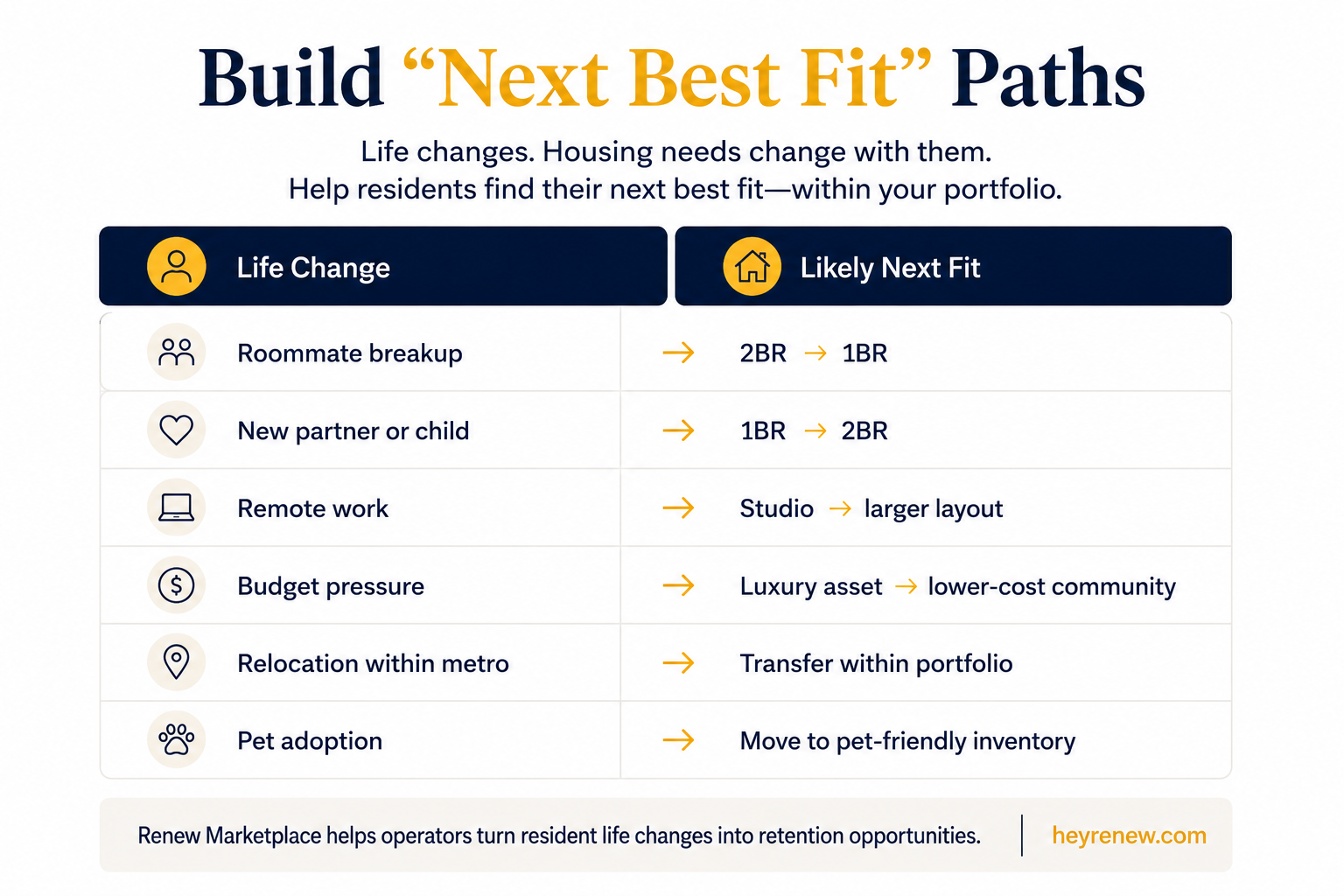
Most operators already understand these patterns intuitively. The challenge is surfacing the right next-fit options early enough to influence the outcome.
Traditional lease renewal systems weren’t built for that. Once a resident submits an NTV, the relationship usually shifts from retention to replacement.
Renew Marketplace creates a different path.
Instead of immediately exiting the operator ecosystem, residents explore other apartments based on the context operators already have — budget, unit type, location preferences, lease timing, and other resident signals.
That changes the role of retention itself. It becomes less about preserving a single lease and more about maintaining the resident relationship across life changes.
Make Resident Mobility Part of Your Retention Strategy
A meaningful share of move-outs are still highly qualified renters actively searching for their next apartment. Through Renew Marketplace, operators can keep participating in that decision instead of losing visibility the moment an NTV is submitted.
That shift has implications far beyond renewals. It affects marketing efficiency, vacancy exposure, resident LTV, and how much demand operators have to reacquire over time.
The strongest retention strategies are starting to reflect that reality. They’re becoming less focused on keeping every resident in the same apartment and more focused on helping residents navigate what comes next.
Because sometimes the best retention strategy is helping residents transition within your ecosystem, instead of losing them to someone else’s.


.png)
.png)
.png)
.png)
.png)
.png)
.png)
.png)
%20(1).png)
.png)
.png)
.png)
.png)
.png)
.png)

.png)
.png)
.png)
.png)
.png)
.png)
.png)
.png)
.png)
.png)

.png)

.png)






.png)
.png)
.png)