.svg)

.svg)


.png)
Multifamily has spent the last few years getting dramatically better at resident communication.
Today's AI leasing assistant tools can answer questions instantly, schedule tours, qualify prospects, and help site teams manage resident communication at a scale that wasn't possible a decade ago.
That's real progress — with a blind spot.
A lot of the conversations around multifamily AI still assumes the most valuable resident insights come from conversations in the first place.
For new leases, that might be true. But after move-in, many of the decisions operators care about most take shape long before they become a conversation.
What AI Leasing Assistants Do Well
The rapid adoption of AI leasing assistants is easy to understand. These tools help operators handle a growing volume of resident and prospect interactions without requiring a proportional increase in staffing.
Many of today's solutions are especially effective at:
- Answering common resident and prospect questions instantly
- Scheduling tours without requiring staff involvement
- Qualifying prospective residents before a leasing conversation
- Providing 24/7 communication coverage
- Reducing repetitive administrative work for site teams
- Improving response times and communication consistency
- Capturing and organizing conversation data
- Supporting centralized leasing and operations models
These capabilities create real value for operators. Faster responses improve the resident experience, reduce workload for site teams, and make it easier to manage communication at scale.
But every conversation comes with the same limitation: You only learn what a resident chooses to share.
Where AI Leasing Assistants Fall Short
Conversation data can surface resident concerns, preferences, and intent — up to an extent.
Because it’s inherently self-reported, it only tells you:
- What a resident chooses to communicate
- When they choose to communicate it
- How they choose to frame it
- Whether they engage at all
At renewal, that creates a challenge.
Residents don’t usually tell you they're considering a move while they're still considering it. By the time a resident does share they're leaving because of price, location, or another factor, the decision has often been forming for weeks or months.
Plenty more residents never explain their thinking at all. Some might talk through their options. But others decide well before anyone realizes they're even considering a move.
That's the limitation of any conversation-based system: it can only learn from a conversation that happens, to the extent it happens candidly. When residents don’t engage, or don’t engage fully, there's no signal to capture.
But the signals are there. You just have to look beyond the conversation — and toward resident behavior — to find them.
Why Behavioral Signals Are So Valuable For Multifamily AI
One of the most common assumptions in multifamily is that renewal intent appears during the renewal window.
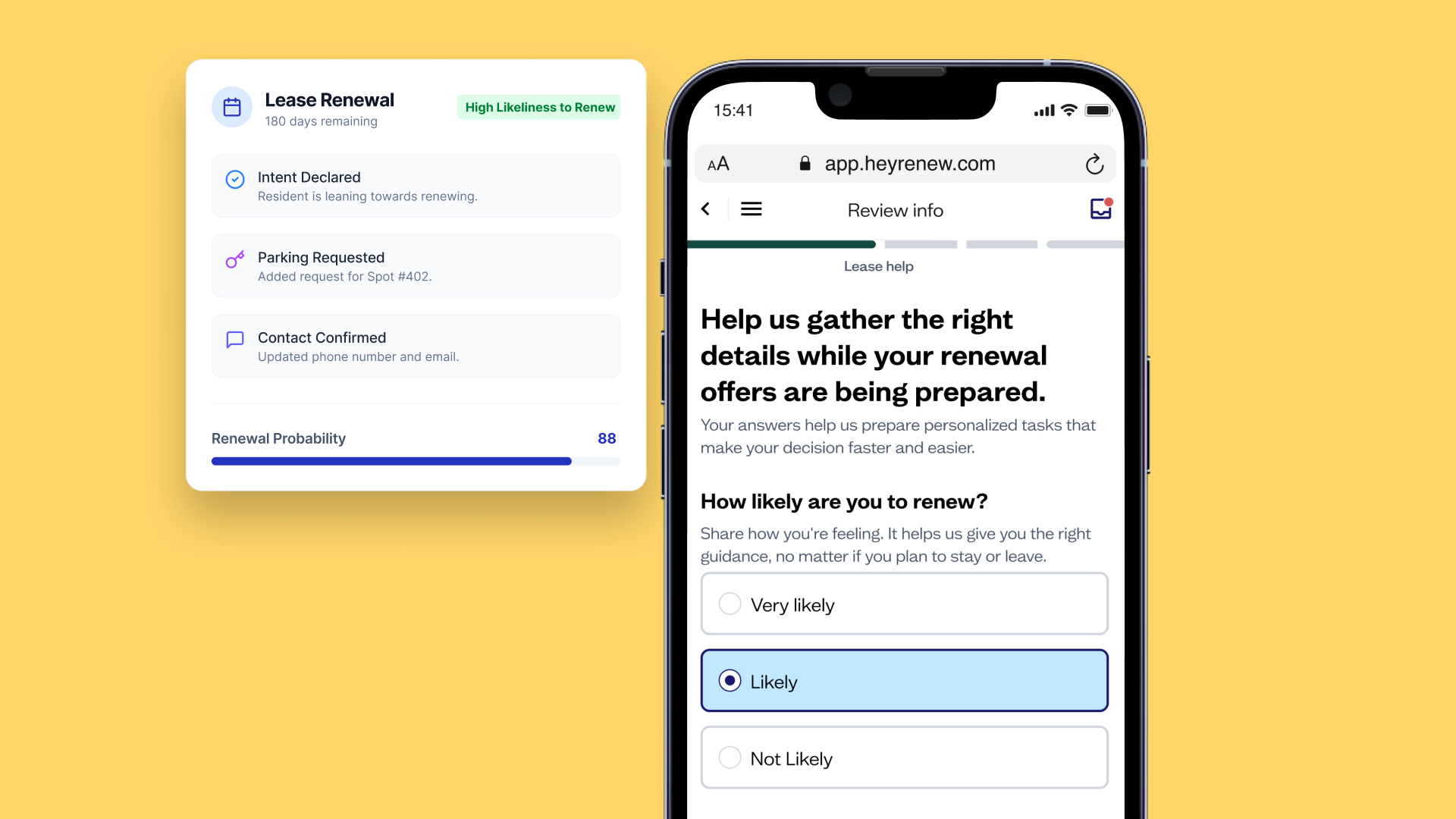
In reality, residents are often weighing stay-or-go decisions long before they're ready to talk about them. During that process, they leave behind a trail of behavioral signals, like:
- Opening a renewal offer multiple times in a short period
- Comparing lease terms and pricing options
- Revisiting the resident portal after receiving an offer
- Exploring larger floor plans or transfer opportunities
- Browsing higher-priced units within the portfolio
None of these actions guarantees a move-out or renewal. On their own, they may not mean much.
The value comes from the pattern.
When multiple behaviors start pointing in the same direction, they can reveal what a resident is actively weighing before a survey response, chatbot interaction, or notice submission ever occurs.
That's what makes behavioral data so valuable. It appears sooner, keeps accumulating throughout the resident journey, and doesn't depend on a resident deciding to engage in the first place.
Most importantly, behavior can reveal what residents are considering while they're still figuring out what they want to do next. That's often the period where operators have the greatest opportunity to influence an outcome rather than simply reacting to it.
The Behavioral Signals Operators Should Be Tracking Today
Once you start looking beyond conversations, a different set of signals comes into view.
Building a stronger retention strategy starts with paying closer attention to five categories of resident behavior:
Renewal Offer Engagement
Some of the strongest intent signals emerge after an offer is delivered and before a decision is made. Understanding how residents engage during that period can help operators identify opportunities to intervene, personalize, or forecast more accurately.
Signals to watch:
- Time to first offer view
- Repeat offer visits
- Pricing comparisons
- Lease term comparisons
- Decision timing
Resident Portal Activity
Residents often return to the same information multiple times while weighing a decision. Activity patterns within the resident portal can help reveal where residents are spending time, what they're revisiting, and what may be driving their attention.
Signals to watch:
- Journey progression
- Activity gaps
- Re-engagement patterns
- Offer response timing
- Stage-by-stage conversion
Portfolio Exploration
When residents start evaluating different floor plans, communities, or price points, they're often trying to solve a problem. Those behaviors can help operators understand evolving priorities before they're communicated directly.
Signals to watch:
- Floor plan searches
- Transfer activity
- Marketplace engagement
- Different price points
- Alternative lease options
Communication Engagement
Conversations still remain an important piece of the puzzle — when combined with behavioral signals. These patterns can help operators validate emerging trends, identify changes in engagement, and better understand resident intent.
Signals to watch:
- Response rates
- Outreach engagement
- Communication timing
- Channel usage
- Changes in responsiveness
Experience & Satisfaction Indicators
Behavioral signals can tell you intent is changing. Experience signals help explain why. Service interactions, maintenance experiences, and satisfaction trends can provide critical context behind the resident decisions you're observing.
Signals to watch:
- Maintenance activity
- Resolution timelines
- Service interactions
- Satisfaction trends
- Post-issue engagement
The Next Generation Of Proptech AI Will Focus On Intent, Not Just Conversations
The first wave of multifamily AI focused on answering a simple question: How quickly can we respond?
The next challenge is different. Operators don't just need to understand what residents are saying today. They need to understand what residents are likely to do next.
That's where the distinction between conversation intelligence and retention intelligence becomes important:
→ Conversation intelligence helps operators understand what was said.
→ Retention intelligence helps operators understand what behaviors are emerging, what decisions are taking shape, and where intervention opportunities still exist.
Those are fundamentally different capabilities.
One helps manage interactions. The other helps influence outcomes.
For operators, that difference matters — because retention opportunities don't begin when a resident submits notice. They begin much earlier, while intent is still forming and decisions are still being made.
That's the thinking behind Signal within Renew's Resident Intent Intelligence Platform. Signal surfaces the behavioral signals that precede renewal decisions, helping operators identify renewal risk and resident disengagement up to six months before lease end — while there’s still time to change outcomes.


.png)
.png)
.png)
.png)
.png)
.png)
.png)
.png)
%20(1).png)
.png)
.png)
.png)
.png)
.png)
.png)

.png)
.png)
.png)
.png)
.png)
.png)
.png)
.png)

.png)
.png)

.png)

.png)






.png)
.png)
.png)