.svg)

.svg)


.png)
AI in property management is quickly becoming core to how multifamily portfolios operate. What started as point solutions for leasing, maintenance, and pricing is now shaping how decisions get made across the entire portfolio.
As more multifamily AI tools enter the market, choosing the right ones gets harder. Many platforms promise similar capabilities, and with new solutions launching constantly, consolidation can feel like the simplest path. It’s tougher to tell which tools actually influence portfolio performance — and which ones add activity without changing outcomes.
In this article, we’ll break down:
- The core categories of AI support for large multifamily portfolios
- Where each type of AI tool adds value
- How these tools fit together within a modern portfolio
And we’ll also explore why today’s “do-it-all” platforms fall short, with tips on what leading operators prioritize instead: targeted depth, clear visibility across the lease lifecycle, and systems that share signals, so teams can act with better timing and context.
Because at scale, performance isn’t driven by any single feature or platform. It’s shaped by how well your multifamily AI tools work together to support decisions, from first touch through renewal.
The Myth of the “All-in-One” Multifamily AI Platform
As AI property management technology expands, more vendors are positioning their platforms as complete solutions for multifamily operations. The promise is straightforward: one system to manage leasing, maintenance, communication, pricing, and analytics.
It’s an appealing idea. But in practice, large operators tend to run into tradeoffs.
Multifamily AI platforms built to cover every property management function often lack depth in revenue-critical areas. That can look like:
- Leasing activity without full lifecycle context. With a generic all-in-one tool, lead response and tour volume may be tracked, but those signals usually aren’t connected to outcomes like conversion quality, lease duration, or resident stability. Filling units quickly is easier, but prioritizing stronger demand isn’t.
- Pricing decisions without operational or behavioral inputs. In a non-specialized solution, market data and availability might inform rents — but signals from resident behavior, service experience, or onsite operations don’t. Pricing responds to the market, but not always to what’s happening inside the portfolio.
- Communication without performance awareness. In do-it-all platforms, communication is typically automated at scale, with limited context. Messaging can go out without considering service issues, engagement patterns, or resident lifecycle stage, reducing its ability to meaningfully influence outcomes.
With that in mind, what does a stack with the right capabilities actually look like?
How Leading Operators Structure Their AI Stack
For large portfolios, performance depends on two things: depth within each function and coordination across them.
Top operators hit that balance by combining targeted tools that go deeper and integrate cleanly — so every part of the stack contributes to performance in a specific, measurable way. That looks like using:
→ Leasing tools to optimize conversion and demand quality.
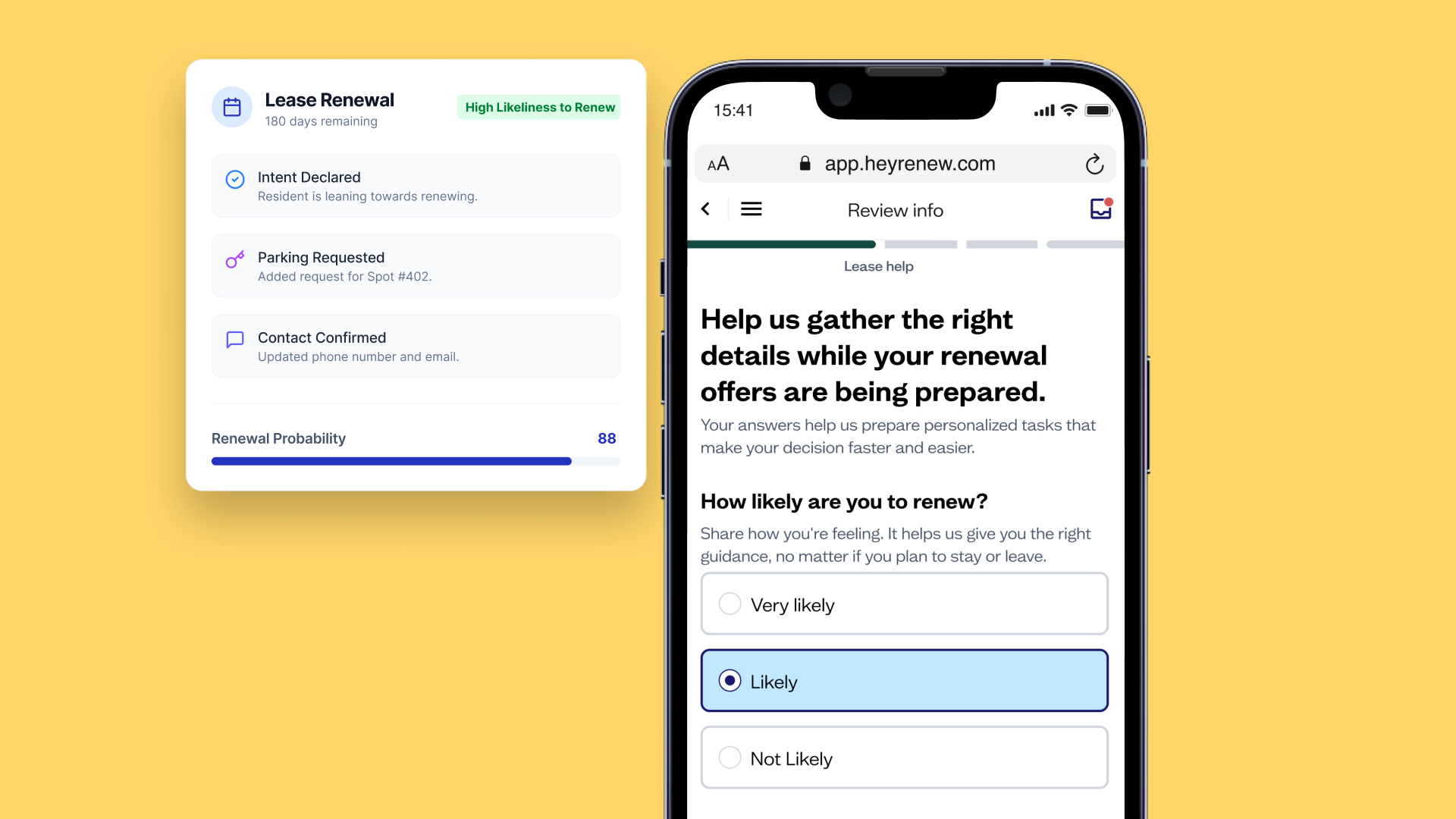
→ Renewal and retention tools to surface resident intent early and prevent vacancy loss.
→ Communication tools to adapt messaging to resident behavior and lifecycle stage.
→ Pricing tools to respond to both market conditions and portfolio signals.
On their own, each tool improves individual decisions. When connected, they reinforce each other across the lease lifecycle — so multifamily AI can influence outcomes, not just optimize individual tasks.
So, which types of tools belong in your integrated stack — and how should you evaluate them? We’ll break down the core categories of AI property management software next, and what to look for in each.
The Core Categories of AI Property Management Software
Most AI tools for property management fall into a few core operational categories. Each plays a distinct role in how performance is managed at the portfolio level.
Understanding how these categories work — and how they fit together — helps operators build a stack that shapes occupancy, retention, and revenue.
1. AI Leasing Optimization and CRM Systems
AI leasing tools streamline lead qualification, tour scheduling, and follow-up, helping centralized teams manage demand for multiple communities.
Benefits
- Faster response times and higher tour conversion
- Increased occupancy velocity
- More efficient use of centralized leasing teams
- Better prioritization of high-value prospects
Where It’s Most Effective
Leasing tools have the greatest impact at the beginning of the resident lifecycle, with influence tapering after move-in.
Most leasing systems don’t provide visibility into retention signals or structured workflows to support renewal decisions — leaving operators without a way to protect the residents they’ve already invested to acquire.
Features to Look For
- Lead scoring based on conversion likelihood and lease quality
- Automated, multi-channel follow-up
- Source-level performance tracking
2. AI-Driven Operations and Predictive Maintenance
AI-driven operations tools help centralized teams manage maintenance, vendors, and asset performance across properties.
Benefits
- Reduced emergency repair costs
- Faster unit turns
- More predictable maintenance scheduling
- Improved resident experience and satisfaction
Where It’s Most Effective
These tools are strongest in improving operational efficiency and consistency throughout the portfolio. Their impact centers on cost control and service quality, with indirect influence on broader portfolio performance.
Features to Look For
- Predictive diagnostics based on service history and usage
- Automated work order routing and prioritization
- Portfolio-level maintenance visibility
3. AI Resident Communications
AI communication tools automate resident interactions from first inquiry through ongoing residency.
Benefits
- Faster, more consistent communication
- Scalable support across large portfolios
- Improved transparency and responsiveness
Where It’s Most Effective
Communication tools excel at delivering messages at scale and maintaining consistent resident touchpoints.
But communication alone doesn’t create insight. Without underlying signals, these tools can’t distinguish which residents require attention or when outreach will have the most impact.
Features to Look For
- Multi-channel messaging (SMS, email, portal)
- Behavioral triggers for automated outreach
- Integration with leasing and operations systems
4. AI Revenue Management and Rent Forecasting
Revenue management platforms use market data, demand signals, and lease timing to guide portfolio-level pricing decisions.
Benefits
- Optimized rent pricing at scale
- Increased revenue capture
- Portfolio-level pricing consistency
Where It’s Most Effective
These tools have a direct impact on revenue by aligning pricing with market demand.
Their effectiveness increases when paired with internal signals. Without visibility into resident behavior or renewal likelihood, pricing decisions reflect the market but miss important context within the portfolio.
Features to Look For
- Dynamic pricing models
- Market and internal data integration
- Forecasting and scenario planning
5. AI Fraud Screening and Verification
AI fraud detection tools identify high-risk applications before approval.
Benefits
- Reduced bad debt and eviction risk
- Higher-quality resident base
- Fewer operational disruptions
Where It’s Most Effective
From a lifecycle perspective, fraud detection improves the quality of leases entering the portfolio. However, like leasing optimization, it primarily protects the front end of the resident journey.
Features to Look For
- Identity and income verification automation
- Pattern recognition across applications
- Integration with leasing workflows
6. AI Renewal and Retention Management
Renewal and retention tools focus on influencing lease outcomes — where occupancy stability and long-term NOI are ultimately determined.
Benefits
- Visibility into renewal likelihood and churn risk
- Reduced vacancy loss through proactive intervention
- Increased renewal rates and lease extensions
- More predictable occupancy and revenue
Where It’s Most Effective
These tools operate in the window before lease decisions are finalized, when timing, incentives, and outreach can still change the outcome.
They combine signals from multiple systems to flag residents at risk, identify likely renewals or transfers, and guide teams toward the right action — whether that’s adjusting offers, prioritizing outreach, or retaining demand within the portfolio.
This is where occupancy is stabilized and NOI is protected.
Features to Look For
- Resident intent modeling based on engagement, behavior, and lease timing
- Portfolio-level visibility into renewal trends and risk
- Workflow automation for outreach, incentives, and lease offers
- Integration with pricing, communication, and leasing systems
Explore the difference our AI-powered renewal management engine makes for NOI.
How to Choose AI Solutions for Multifamily Communities: Questions to Ask
Not every portfolio needs the same mix of tools. The right stack for you depends on where performance is breaking down today, and which types of multifamily AI solutions are designed to address it.
Before evaluating specific platforms, step back and assess which AI capabilities your portfolio actually needs by asking yourself:
1. Where is performance most at risk right now — at acquisition, during the lease, or at renewal?
Is your biggest gap at acquisition, during the lease, or at renewal?
If units are sitting vacant, AI leasing tools that improve response time, lead qualification, and conversion may be the priority. If occupancy is slipping despite strong demand, the issue may sit later in the lifecycle — pointing to a need for AI renewal and retention tools.
2. How much visibility do I have into resident intent before lease decisions are made?
Can you identify which residents are likely to renew, transfer, or churn — and when? Or are you reacting after decisions are already finalized?
If you can’t identify likely move-outs ahead of time, AI-powered lifecycle analytics and renewal management tools could be critical, so you can act before outcomes are locked in.
3. Are my pricing decisions informed by what’s happening inside my portfolio, or just the market?
Some AI pricing tools rely heavily on market comps and availability.
If your pricing doesn’t reflect leasing velocity, resident behavior, or renewal risk, look for solutions that incorporate both market data and portfolio-level signals.
4. Where are teams spending time on manual work that doesn’t improve outcomes?
AI is often used to automate repetitive tasks, but the real value comes from how that automation supports outcomes.
If teams are throwing away time on leasing follow-up, communication, or maintenance coordination, AI tools in those categories can improve speed and consistency while still allowing teams to focus on higher-impact decisions.
5. Do my systems share signals, or operate in isolation?
Too many property management tools are deployed in isolation.
If your leasing, operations, pricing, and communication tools don’t share signals, you might benefit from an AI platform or integration that allows those systems to work together — so insights can inform decisions across the lease lifecycle.
6. How early can my team take action on risk or opportunity?
Timing matters as much as the quality of an insight itself.
If your current tools surface issues only after a vacancy, pricing miss, or non-renewal, you may need AI solutions that identify risk earlier — especially around resident intent — so you can act while outcomes are still in play.
The Future of AI in Multifamily Operations
As AI adoption accelerates, operators are realizing that integration matters more than feature count.
Individual tools can improve specific workflows. But when leasing, operations, pricing, and lifecycle systems share signals, they start to function as a coordinated system — where insights carry through the resident lifecycle and decisions are made with full context.
That’s where performance shifts.
The next phase of multifamily AI and property management automation won’t be defined by more standalone tools. It will be shaped by how well those tools connect, turning specialized capabilities into a system that supports execution and forecasting for the entire portfolio.
For large portfolios, the goal is straightforward: consistent execution within centralized teams, clear visibility into lifecycle performance, and AI systems that bring those two together to drive results.
Ready to connect AI to real revenue?Get a demo to see how our AI-powered renewal and retention platform helps teams surface resident intent early, act at the right time, and protect NOI across your portfolio.


.png)
.png)
.png)
.png)
.png)
.png)
.png)
.png)
%20(1).png)
.png)
.png)
.png)
.png)
.png)
.png)
.png)

.png)
.png)
.png)
.png)
.png)
.png)
.png)
.png)
.png)

.png)

.png)






.png)
.png)
.png)