.svg)

.svg)



If it feels like your onsite team’s job description has quietly doubled, you’re not imagining it. Today’s leasing pros juggle lead intake and qualification, call coverage, text and email follow-ups, CRM hygiene, ILS updates, self-guided and virtual tours, ID/fraud checks, pricing conversations, reputation management, renewals, delinquency nudges, and a nonstop stream of resident communications and issues. Meanwhile, labor markets remain tight and turnover is stubbornly high across onsite functions. The result: burnout, inconsistent execution, and—most dangerously—retention left to “when we have time.”
It’s time to stop pretending the same people, processes, and generalist tools can optimize both acquisition and renewals. Retention deserves its own operating system.
The job has ballooned—and it isn’t slowing down
Over the last few years, the scope of leasing has expanded in three big ways:
- Omnichannel lead handling: Prospects expect instant replies on phone, email, text, chat, and social. Many properties still miss a significant share of calls/messages during business hours; in one industry analysis, only about half of properties expected they could handle all incoming calls without help—an obvious sign of load and leakage. LeaseHawk
- Digital touring & content: Unit-level virtual tours are now table stakes, and they materially move the needle (40% more leads and 72% more leases in one large data set). Someone has to create, publish, and maintain that content. Multi-Housing News+1
- Tech stack sprawl: CRMs, ID verification, pricing tools, centralized scheduling, marketing automation, fraud screening, and reputation platforms all promise efficiency—but they also create coordination overhead if they aren’t integrated or purpose-built for the leasing/renewal journey. Even vendor guidance now argues for tighter CRM integration to reduce swivel-chair work. AppFolio+1
Layer on the macro reality: onsite roles have high churn. NAA’s employee engagement data pegs onsite leasing turnover at ~32% (and onsite maintenance even higher), a rate that’s risen since 2010—so teams are frequently short-staffed or onboarding new hires while trying to keep the airplane in the air. NAHRA
Surveys through 2024–2025 found operational efficiency and staffing remained top challenges; mental-health distress is notably concentrated among onsite leasing professionals. That’s not just a people problem—it’s a performance risk for your portfolio. AppFolio+2The Guarantors+2
The business math: renewals are the highest-ROI lever you have
Two truths can coexist: new leases matter, and retention matters more to NOI predictability. Consider:
- Turnover is expensive. Multiple sources peg average total turnover cost—lost rent, make-ready, marketing, concessions—at ~$3,872 per move-out (often $3k–$5k). With vacant days lengthening versus pre-pandemic norms, each extra day compounds the hit. Multifamily Dive+2Multi-Housing News+2
- Renewal rates are elevated—if you can capture them. RealPage tracked U.S. renewals around 54–55% in late 2024, continuing at an average of 55% by mid-2025, well above long-term norms. Other sources quote retention as high as 63%. That’s a tailwind you can miss without dedicated focus. RealPage+2RealPage+2
When acquisition activity is noisy (record supply, flat rent growth in many markets), a reliable renewal engine stabilizes occupancy and smooths cash flows. Yet in most org charts, renewals still “live” with leasing—competing for attention with tours, lead traffic, and urgent day-to-day fires.
Why invest in a dedicated retention system (people + process + platform)
1) Specialization beats multitasking.
Renewals require a different muscle than first-touch sales: data-driven pricing and offer logic, lifecycle communications, objection handling on rent deltas, and proactive service recovery for at-risk households. Carving out an accountable retention function (centralized or hybrid) lifts consistency and frees onsite to excel at tours and move-ins. Even vendor whitepapers and case studies now emphasize centralized workflows to reduce handoffs and speed decisions. RealPage
2) A purpose-built workflow closes gaps.
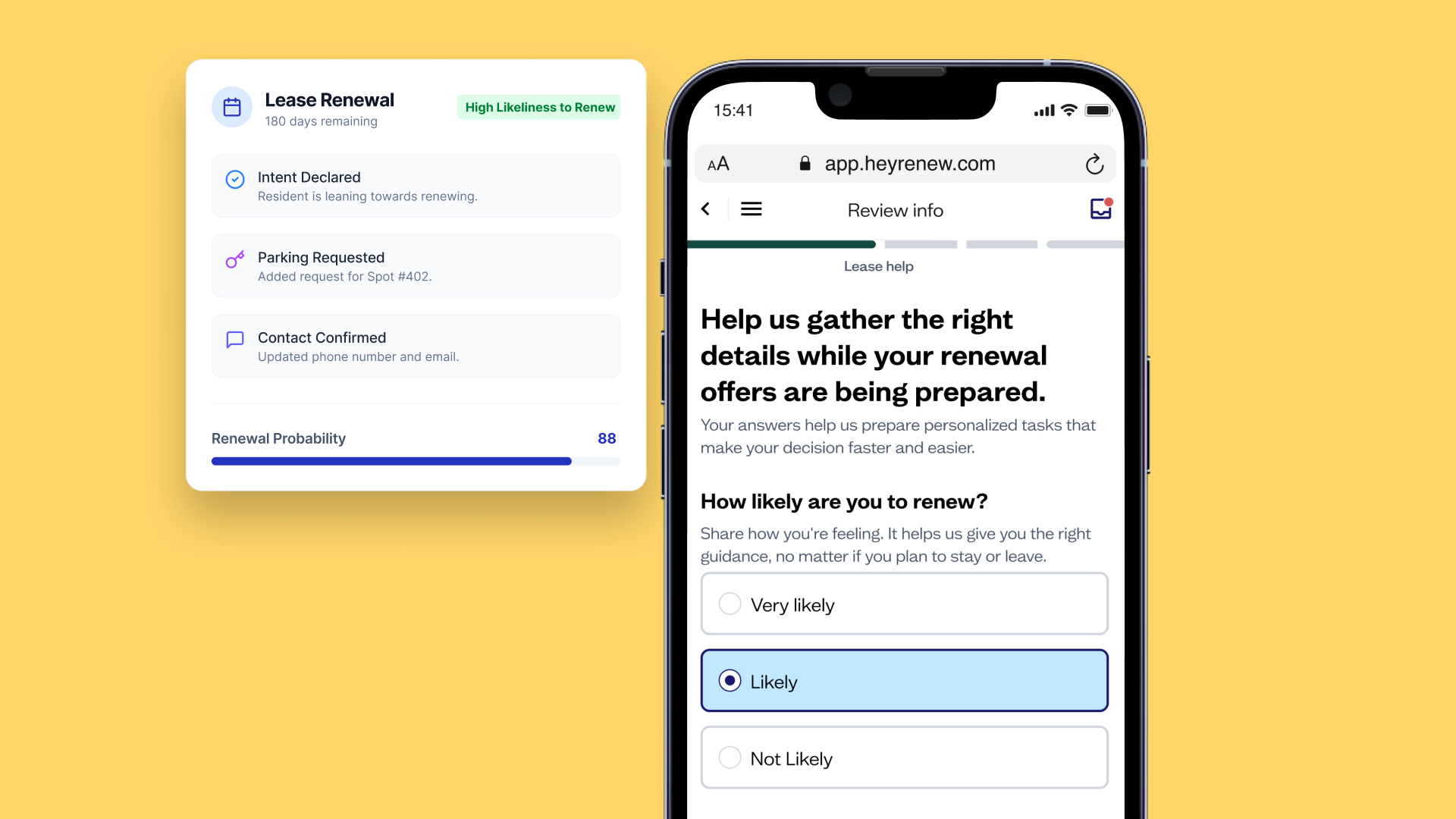
General CRMs track activities; a retention system orchestrates the sequence: offer creation, multi-channel outreach, nudges, counter-offers, exception routing, and owner approvals—plus visibility into who’s likely to renew (and why). Operators report material cycle-time reductions when renewal tasks are automated and centralized, shrinking the decision window from ~45 days toward the 10–15 day range in some deployments. (That time compression matters when you’re trying to forecast expirations and make-ready loads.) heyrenew.com
3) It protects teams from burnout.
Moving repetitive, timing-sensitive follow-ups off the onsite plate meaningfully reduces context switching. That doesn’t just help morale; it increases capture of already-inclined renewers—the lowest-cost “lease” you’ll ever sign. Industry mental-health and workload surveys underscore the need to redesign roles, not just “try harder.” The Guarantors+1
4) It’s measurable and owner-friendly.
A true retention OS exposes KPIs owners actually care about: renewal rate versus target, time-to-decision, offer acceptance by rent-change band, save rates on at-risk residents, vacant-days avoided, and dollars of turnover cost prevented. With vacant days up ~4 vs. early 2020, even small cycle-time gains pay back quickly. RealPage
What a dedicated retention program looks like
People
- Stand up a Retention Team (centralized specialists or a “pod” per region).
- Assign clear SLAs: touches per resident, response times, escalation paths.
- Train specifically on renewal objections (price delta, service issues, life events) and service-recovery playbooks.
Process
- Start outreach 90–120 days pre-expiration with tiered cadences by risk and rent-change band.
- Standardize exception handling (approval matrices) so offers don’t stall.
- Align with maintenance to pre-empt issues that kill renewals (work orders, safety). Resident priorities routinely differ from manager assumptions—close that gap. Multifamily Dive
Platform
- Use a retention-first system that integrates pricing, automates offer generation and follow-ups across channels, tracks negotiations, and produces portfolio-level insights.
- Ensure it plugs into your property management software and CRM to eliminate duplicate data entry and missed touches. AppFolio
The KPI shift that changes everything
Stop asking onsite teams to “do a better job following up on renewals” between tours. Give retention ownership and instrumentation. Track:
- Renewal rate vs. goal (and by rent-change cohort)
- Time-to-decision and time-to-counter
- Save rates on at-risk households (service-recovery wins)
- Vacant days avoided and turnover dollars prevented (use that ~$3.9k benchmark per non-renewal) Multifamily Dive
Tie results to incentives for the retention team, not just general leasing commissions. When you make renewals visible and owned, they improve—fast.
Bottom line
Your teams aren’t underperforming; they’re overloaded. In a year when vacancy days have stretched and labor is tight, the most owner-friendly thing you can do is specialize: carve out a retention function, give it a purpose-built system, and run it with the same rigor you apply to lead gen. The payoff—stabilized occupancy, fewer costly turns, and happier teams—shows up quickly on the P&L.


.png)
.png)
.png)
.png)
.png)
.png)
.png)
.png)
%20(1).png)
.png)
.png)
.png)
.png)
.png)
.png)
.png)

.png)
.png)
.png)
.png)
.png)
.png)
.png)
.png)
.png)
.png)

.png)

.png)





.png)
.png)
.png)