.svg)

.svg)


.png)
Most residents aren’t going to walk into the leasing office and announce their resident satisfaction has declined 17% since last quarter.
If something starts feeling off, you’re more likely to see it around the edges first:
- They stop engaging.
- A maintenance issue that once would have been a minor annoyance starts carrying more weight.
- They ask a few more questions about their lease.
- They’re suddenly very interested in exactly how much notice they need to give.
Individually, those behaviors could be explained away. But together, they tell you that the resident’s relationship with their home is changing.
That matters, because satisfaction and renewal decisions don’t exist in separate universes. Catching dissatisfaction early gives operators more time to address what’s driving it — and keep fixable concerns from becoming move-outs.
So, with that in mind:
How Can Resident Satisfaction Be Gauged?
For years, the obvious answer has been: ask residents.
It’s true that a (strategic) resident satisfaction survey can tell you a lot. So can online reviews, maintenance feedback, conversations with site teams, and — to some degree — chatbots. They give residents a direct opportunity to say what’s working, what isn’t, and what they wish would change.
The trouble is that they depend entirely on residents telling you.
Some residents will happily write three paragraphs about the gym equipment. Others could be halfway to Zillow before mentioning that anything is wrong.
There’s also the question of timing. A quarterly survey tells you how someone felt when they hit “submit.” But their day-to-day experience — and their renewal plans — can keep changing afterward.
That’s why operators should pay attention to both declared feedback and ongoing behavior. Changes in a resident’s engagement, communication, requests, and predictive renewal intent scoring can add context that a survey alone can’t provide.
With Resident Retention Intelligence, satisfaction pulse checks start well before the traditional renewal window. Pre-renewal engagement captures lightweight satisfaction signals alongside declared intent. And dynamic Propensity to Renew scoring captures the behavioral drift signals that never make it into words.
You might also like: The Future of Resident Retention Is Behavioral Intelligence
So, what dissatisfaction signals should operators be watching for?
7 Early Warning Signs That Resident Satisfaction Is Slipping
1. Resident Engagement Starts Falling Off
This doesn’t necessarily look like your most engaged resident becoming a total ghost overnight. It could show up when:
- A resident used to respond quickly, and now doesn’t.
- They stop interacting with resident communications.
- They ignore pre-renewal outreach they previously would have opened.
- They start pulling back from the parts of the resident experience they once used or valued — like community events, amenities, or other parts of day-to-day life at the property.
Low resident engagement on its own doesn’t automatically mean dissatisfaction. Some perfectly happy residents would prefer to pay their rent, receive zero emails, and otherwise be left in peace.
The more interesting signal is a change from that resident’s normal behavior.
Think trajectory rather than benchmark. A consistently quiet resident may simply be quiet. A previously engaged resident who suddenly goes dark deserves a little more attention.
2. Small Maintenance Issues Start Carrying More Weight
Every maintenance request isn’t a resident retention crisis. Sometimes a garbage disposal is just a garbage disposal.
But unresolved and repeated problems have a way of accumulating.
Say a resident submits the same request twice. A fix doesn’t stick. A minor inconvenience turns into a frustrated follow-up. Several unrelated resident concerns start piling up.
The individual issue may seem small from the property’s side. For the resident, it can become part of a bigger story about what it feels like to live there.
That’s especially important when teams look at maintenance issues as closed tickets rather than part of the broader resident relationship. “Completed” in the system doesn’t always mean “resolved” in the resident’s mind.
Pay attention to repetition, escalation, and changes in how residents respond. Those can tell you more than the work-order count alone.
3. Alternatively, They Stop Asking You to Fix Things
A frustrated resident doesn’t always complain more. Sometimes they stop complaining altogether.
That maintenance issue they would have reported six months ago? They live with it. The follow-up email never comes. The resident who used to flag problems starts deciding they’re no longer worth the trouble.
Silence can look like satisfaction in a dashboard. In reality, it can also mean a resident has lowered their expectations of the property, or decided they won’t be around long enough to care.
That’s why fewer complaints aren’t automatically good news. Again, the meaningful question is whether a resident’s behavior has changed. When someone who used to give you opportunities to make things right stops giving them, that can be its own warning sign.
You might also like: What Renters Want: The Data On Why Residents Move Out
4. Their Tone Changes in Resident Communications
Sometimes residents are still plenty engaged on paper. The change is less what they’re saying, and more how they’re saying it:
- Friendly exchanges become more transactional.
- Routine questions come with more frustration.
- A resident starts raising concerns they hadn’t mentioned before.
- They revisit issues they seemed to have already moved past.
Any one prickly email could just be a bad Tuesday. But a sustained shift in resident communication can add another piece to the satisfaction picture.
That’s especially true when the shift lines up with behavioral changes elsewhere. What a resident says is always at its most useful when you can consider it alongside what they do.
5. Their Questions Start Sounding a Lot Like Exit Planning
There are normal lease questions.
And then there’s the sudden burst of:
- When does my lease technically end?
- How much notice do I have to give?
- What’s the price on your biggest unit?
- Are there fees if I move before my lease is up?
One question doesn’t mean someone has a moving truck booked for Saturday. But a shift toward lease-end logistics, pricing, unit size, or move-out requirements can indicate that a resident is starting to evaluate what comes next.
That evaluation usually begins much earlier than operators realize. Renew identifies resident intent up to six months before lease end, when there’s still plenty of time — and more ways — to influence what happens next.
The earlier you recognize that change, the more options you have. Maybe they need more space. Maybe they’re moving across town. Maybe the issue is price. Maybe another property in your portfolio is actually a better fit.
The sooner you understand what’s driving the questions, the sooner you can show them a reason to stay.
6. Price Sensitivity Suddenly Gets Louder
A resident can love their apartment and still decide they can’t justify the rent.
That’s why satisfaction and affordability need to be considered together.
Watch for residents asking more questions about upcoming increases, fees, renewal pricing, lower-cost units, or ways to reduce their monthly housing expense. A resident who was previously comfortable with their costs may suddenly start doing the math out loud.
This distinction matters, because different risks call for different responses.
If price really is the problem, there may be an opportunity to look at pricing, concessions, a different unit, or an in-portfolio transfer. But if the resident is frustrated by unresolved maintenance issues, shaving a few dollars off the rent may miss the point entirely.
Understanding why someone is leaning away helps teams spend their retention energy and concession dollars more intelligently.
7. Their Renewal Intent Starts Softening
Sometimes, residents do flat-out tell you they’re dissatisfied. You just have to ask early enough.
A resident who once seemed certain about staying may become less sure. Their satisfaction pulse drops. They indicate that they need more space, want a different location, are worried about price, or have another life change affecting their housing plans.
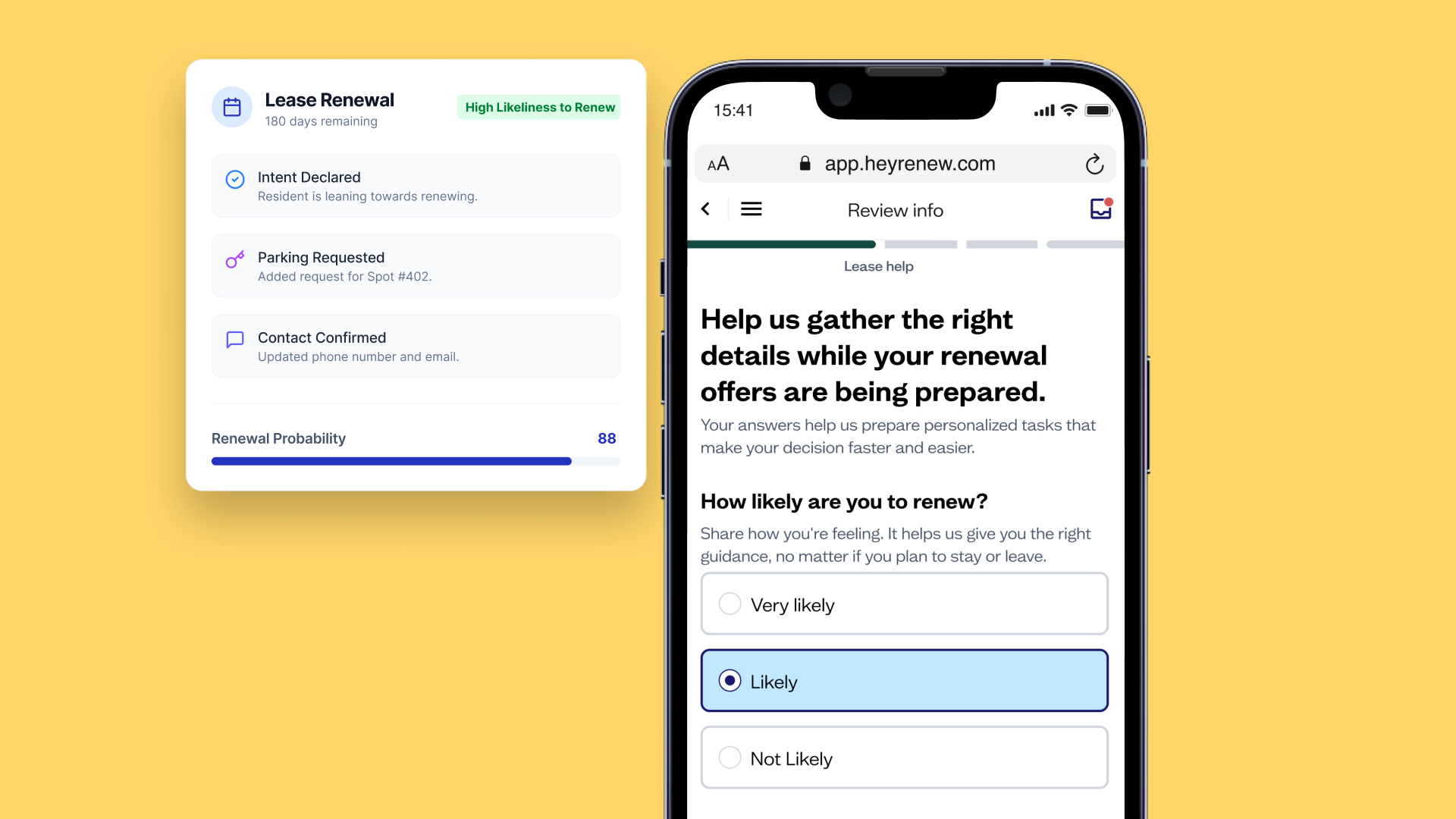
Renew captures these kinds of declared signals months before lease end through its guided Get Ready for Renewal experience. That information feeds into the early intelligence teams use to understand which residents may need attention.
And FYI, “unlikely to renew” still isn’t destiny.
Our data shows that about one in three residents who identify as “not likely” to renew six months out ultimately stay. An early negative signal is useful precisely because there is still an opportunity to change the outcome.
The goal isn’t to predict every resident’s future with a crystal ball but to find the moments when the future is still up for grabs.
What to Do When Resident Satisfaction Starts Dropping
Knowing a resident is growing dissatisfied is useful. Knowing why gives you something to act on.
Price, maintenance, space, location, a life change, or an underwhelming resident experience can all create move risk. The right response depends on what’s actually driving it.
- Find the “why.” Look at what the resident has told you alongside changes in their behavior. A recurring maintenance issue calls for a very different response than an affordability concern or a resident who has simply outgrown their apartment.
- Prioritize where your team can make a difference. Site teams have limited time. When every resident is treated like an emergency, the ones who truly need attention can get lost in the mix. Focus on residents showing meaningful changes while there’s still an opportunity to influence the outcome.
- Match the response to the resident. Fix the maintenance issue. Talk through pricing or a targeted concession. Explore a different floor plan. And if their current apartment or community no longer fits, an in-network transfer can keep the resident within your portfolio even when staying put isn’t the right answer.
- Act while there’s still runway. The earlier you understand what’s changing, the more options you have. Waiting until notice limits what your team—and the resident—can do next.
The best resident experience can’t guarantee that every resident will renew. People move for jobs, relationships, family, space, finances, and a hundred other reasons a property team can't control.
The opportunity is to improve resident experience by catching the changes you can act on early enough to give residents a better reason—or a better way—to stay.
See Dissatisfaction Signals Before They Become a Decline
By the time a drop in resident satisfaction turns into an NTV, the story may have been unfolding for months.
Renew Signal helps operators see that story earlier. It brings together satisfaction, declared intent, engagement, and other resident signals to identify who may be leaning out, understand what’s driving the change, and show site teams where to focus their attention.
That means more time to fix what’s fixable, find another fit within the portfolio, or make the right retention move while the resident is still deciding.
Because the best time to address a move-out is before it becomes one.

.png)
.png)
.png)
.png)
.png)
.png)
.png)
%20(1).png)
.png)
.png)
.png)
.png)
.png)
.png)
.png)

.png)
.png)
.png)
.png)
.png)
.png)
.png)
.png)

.png)
.png)

.png)

.png)






.png)
.png)
.png)